Thursday, September 12, 2013

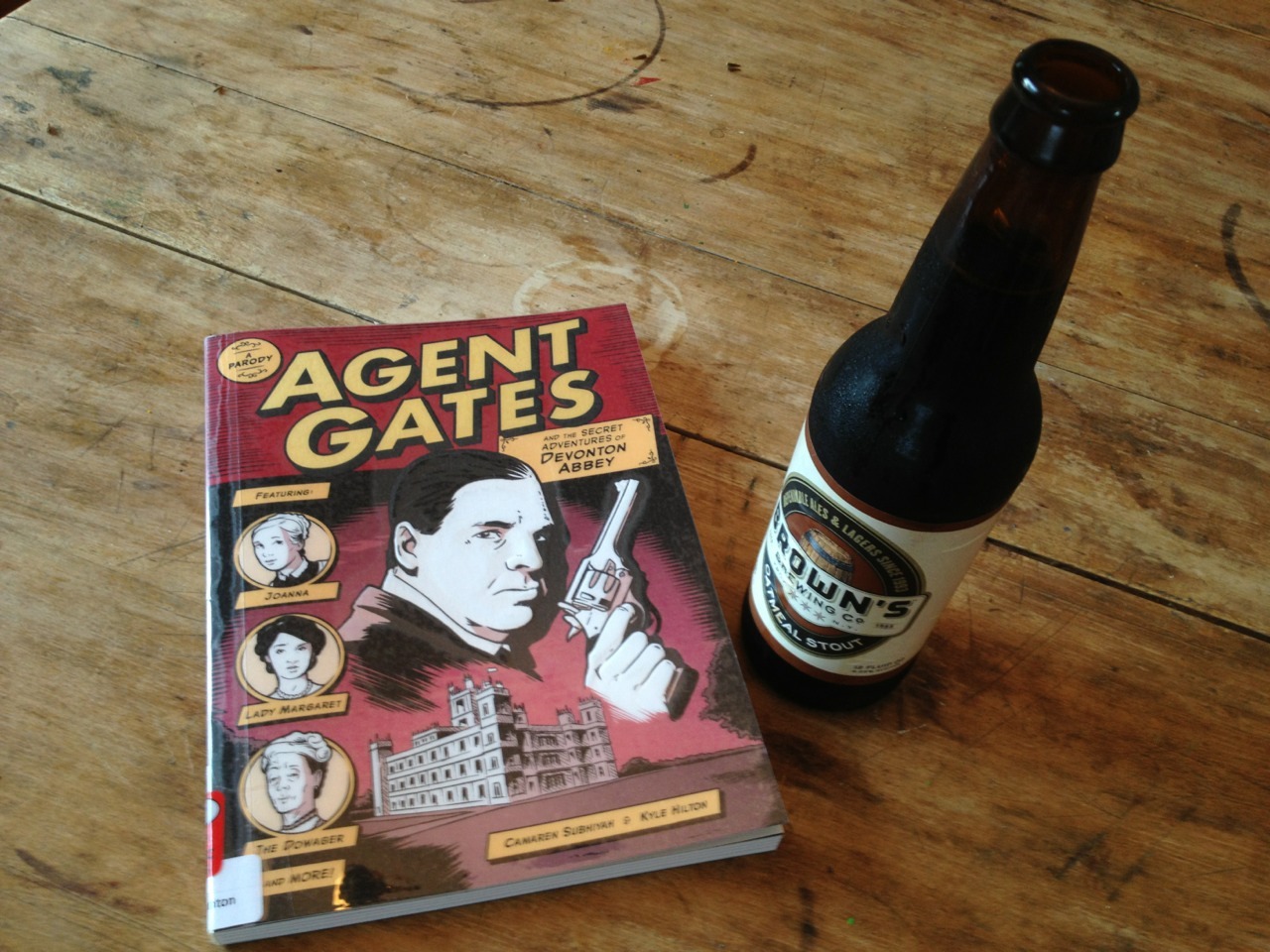
Review: Agent Gates and the Secret Adventures of Devonton Abbey (a parody), by Camaren Subhiyah and Kyle Hilton

It's an intriguing idea for a mash-up: Take the severely reserved characters of the incredibly popular Downton Abbey ITV (and PBS) television series, and re-imagine their story (already tinged with political overtones), changing many of those characters to secret agents. Seems like a can't-miss premise for wacky genre fun, right? And it almost is.

While it's primarily the working-class characters who get to be secret agents, the upper-class characters are almost invariably portrayed as superficial simpletons (Richard Crawhill, Earl of Granville, being the most ridiculous of the ridiculous here). This characterization helps sell the class-conscious narrative, of course, although the parody does descend to some very silly depths. For instance, the inheritance question lying at the center of Downton Abbey here gets an additional wrinkle: if the Crawhills' pregnant dog Sweetsie has a male pup, he will inherit Devonton, and then Lady Margaret won't need to marry Cousin Martin after all. And so on.

Artist Kyle Hilton's character likenesses are usually spot-on, so much so that, except in rare instances, it really does look like you're "watching" a lost episode of the series. Alas, writer Camaren Subhiyah's script isn't content simply to mash-up two genres; instead, it adds strong science-fiction and fantasy aspects to the plot as well, involving elaborate pseudo-scientific gadgetry, the Philosopher's Stone, special mental and physical powers, and more. Oh, and Gates & Co. manage to avert the onset of World War I in the bargain.

It all just seems a bit too over-the-top. The SF aspects threaten to divert the plot too far from parody into, dare I say it, originality. I guess I was looking for something a bit more comfortable in this parody. Agent Gates and the Secret Adventures of Devonton Abbey might have been better served by disguising its Downton-debt and simply telling its original story on its own merits. Although I wonder if it would have been published at all in that case...

Agent Gates and the Secret Adventures of Devonton Abbey (A Parody)
by Camaren Subhiyah and Kyle Hilton
Andrews McMeel 2013
ISBN-10: 1449434347
ISBN-13: 978-1449434342
128 pages, $14.99

Sunday, August 25, 2013

Review: FF vol. 2: The Supremor Seed, by Hickman, Tocchini, Epting, Kitson et al.

Collecting issues #6-11 of the first run of the title FF (which temporarily replaced Fantastic Four), this book continues a cosmic epic begun in who knows which other comics, Fantastic Four or otherwise. Briefly: The Future Foundation (the remnants of the Fantastic Four after the Human Torch has died, plus Spider-Man, plus Dragon-Man, plus Reed Richards' father, plus Reed and Sue's children, plus assorted other younger characters) team up with a bevy of their greatest villains (including Doctor Doom and several others) to stop renegade Reeds from different dimensions from taking over all of everything. At the same time, the Inhumans return from exile. And various mayhems ensue.

Growing up in the 1970s, I always loved the Fantastic Four - I benefited from being able to read the current issues of the title as well as much of the original Stan Lee/Jack Kirby run thanks to the Marvel's Greatest Comics reprint title - and consequently I like to peek in every once in a while to see what's being done with the characters. FF vol. 2 has some interesting moments of characterization, but the plot intricacies rely too heavily on deep continuity knowledge which I don't possess, and which the book itself fails to provide; the Inhumans' storyline in particular is nearly impenetrable, even with an entire issue featuring just them, without a single appearance of the title team. Also, the switch in art styles more than midway through is jarring.

It's a shame, because I did like the book in places. But too much remains unsaid, relying either on previous plot knowledge or too heavily on the art to convey narrative nuances that simply aren't there without accompanying text. The story was, I'm sure, more rewarding to those weekly comics-shop readers who followed several titles as they were published, and who were therefore able to see connections only hinted at in these pages. FF vol 2 is a prime example of a "stand-alone" graphic novel that doesn't.

FF vol. 2: The Supremor Seed
By  Jonathan Hickman, Greg Tocchini, Steve Epting, Barry Kitson et al.
Marvel Comics, 2011
ISBN-10: 0785157697
ISBN-13: 978-0785157694
144 pages, $24.99

Tuesday, July 16, 2013

Review: The Monsters' Monster, by Patrick McDonnell

Patrick McDonnell, the cartoonist behind the already-classic comic strip Mutts, has created a picturebook about monsters whose bad behaviors are very much like those of this book's potential audience. "Who could complain the loudest? Who could throw the most terrible tantrum? Who was the most miserable?" Their most fiendish plot of all involves creating another monster, one whom they hope will be the most terrifying of all. But this Monster (a chunky, cartoonified version of Boris Karloff's portrayal of the Frankenstein monster) has other ideas. I won't give it all away, but I will note that jelly donuts play a part.

McDonnell's artwork is, as always, loose and playful and highly expressive. Little two-headed Gloom 'n' Doom is especially hilarious to watch throughout. The text is clever and a bit sing-songy in places, perfect for reading aloud. And the book's gentle lesson will warm the heart of any little (or big) monster.

"Dank you," Patrick McDonnell.

The Monster's Monster
by Patrick McDonnell
Lttle, Brown, 2012
ISBN-10: 0316045470
ISBN-13: 978-0316045476
40 pages, $16.99

Monday, July 1, 2013

Review: Black Paths, by David B.

David B. is one of my favorite cartoonists: His lush drawings brim over with bold design work, mythological references, and symbolic energy. Epileptic, his account of growing up with a brother who suffered from grand mal seizures and his family's attempts to cope with the situation, remains one of the finest non-fiction graphic novels I've ever read. My French is very poor, but back when I had access to French-language comics I would buy anything with his name on it, just to luxuriate in his imagery, even when my understanding of his verbal nuances was lacking.

Black Paths is a fictionalized account of the Free State of Fiume after the First World War, told mostly through the eyes of Lauriano, a young writer who suffers from his experiences in WWI, and Mina, a French cabaret singer. The book is utterly beautiful: B.'s artwork sings with the addition of color (most of his earlier work I'd encountered was in black and white only), and--as usual for him but unusually for most cartoonists--there are many passages where impressionistic images and non-standard design and layout create beautifully dream-like moments.

However, the ins and outs of political intrigue have never held much appeal to me, and such matters are the meat of this book. Perhaps I simply wasn't in the right mood when I read it, but I could never seem to connect with the narrative in a meaningful way. I am convinced that the fault lies with me, not with the cartoonist, though. One day I'll give this book another chance, which it deserves. It's a bravura exercise in cartooning, but on a subject matter I couldn't seem to relate to. This time.

Black Paths
by David B.
Self Made Hero, 2011
ISBN-10: 190683833X
ISBN-13: 978-1906838331
128 pages, $24.95

Tuesday, June 25, 2013

Review: Spider-Men, by Brian Michael Bendis and Sara Pichelli et al.

The reason this book exists is the very reason that so many people find it hard to "get" superhero comics. Briefly? There's another "Marvel Universe"* outside the regular one with all the heroes you probably know (from the movies if nowhere else**). This "Ultimate universe" has the same heroes, mostly, although with sometimes subtle, other times profound differences. Perhaps the biggest difference is that "Ultimate" Spider-Man--a youthful Peter Parker--died. In the Ultimate universe, at least so far, dead means dead (unlike the regular Marvel Universe, where people die and come back to life over and over, like clockwork). But before too long, Miles Morales, a thirteen-year-old mixed-race youth, gained spider-powers and assumed the mantle of Spider-Man. These two universes existed side-by-side on the comics store shelves for a dozen years, but until Spider-Men, there had never been a cross-over story bringing them together.

If you're confused, you probably don't read superhero comics all that regularly. And therefore, Spider-Men might not be the book for you to start with. Writer Brian Michael Bendis (who's scribed Ultimate Spider-Man from day one) does his best to set the stage(s) for this event: we get a very clear idea of who Peter Parker is, and a somewhat less-clear but still revealing portrait of Miles Morales. The first chapter opens with a several-page monologue by Peter/Spider-Man about why he loves New York City; once Peter gets transported to the Ultimate universe and Miles shows up, we see how the young hero is slowly fitting into the super-fabric of his own version of the city.

But the heart of the book--and I do mean heart--lies in the meeting, mid-point in the narrative, between "our" Peter Parker and the Ultimate versions of Peter's Aunt May May and Gwen Stacy (who, in our universe, was Peter's girlfriend until she was killed at the hands of the Green Goblin, in one of the most momentous story lines in the character's history--a death which haunts him only second to that of his Uncle Ben). Clearly, beyond the hook of the first cross-over between these universes, what writer Bendis is most interested in is these characters.

At first, May and Gwen--like everyone else--chides this adult Spider-Man for dressing up in the dead Parker's costume (his identity having been revealed to the world at his death). Once Peter unmasks and, predictably, May faints at the knowledge that her beloved nephew (at least a version of him) is alive and in her life again, the three characters have a lengthy conversation, which moves from tentative outreach and regret to gradual acceptance and, eventually, a kind of joy.

It's pure soap opera. But then, that's really what superhero comics are, when they work well. The costumes and powers and fights are part of the genre, of course, but the serial nature of superhero comic book storytelling has relied on the emotional histrionics of soap opera since at least the birth of the so-called Marvel Age of Comics in the 1960s. Writer Stan Lee and artist Jack Kirby's Fantastic Four began the trend, but Lee and artist Steve Ditko's Amazing Spider-Man arguably perfected the formula. Bendis and Ultimate Spider-Man artist Sara Pichelli show a lot of comfort working in larger-than-life, character-based psychodrama here.

Pichelli's artwork is lean and clean and very much what good super-hero comic art looks like now, with detailed environments and some very nicely exaggerated spider-poses on our eponymous heroes. But if anything, her depiction of facial expressions is a bit restrained--which would be fine in a literary slice-of-life comic, but super-soap gives you a license to kick up the histrionics. Still, that's a small quibble. I prefer my cartooning a bit more expressive and abstracted (see: Ditko and Kirby again), but as contemporary superhero art goes, this is fine stuff. Layouts are varied but always readable, moving the story forward without much in the way of flashy distractions.

I haven't talked much about the plot or the villain here. But really, beyond the fact that Spider-Man goes to the Ultimate Universe*** and meets not only his replacement but also several other heroes, the plot's incidental to the character interactions. If you haven't read many superhero comics--particularly Spider-Man comics--the character stakes might not mean all that much to you. (Again, serial storytelling means that you get to know these characters in depth; a small verbal aside here can feel freighted with import if you've followed the characters beforehand.) But for regular Spider-Man readers, Spider-Men provides a dose of emotion and a bit of wonder. And Peter's mysterious discovery at the very end ensures that there will be more where this story came from, in some other fashion.

*Actually, there are an infinite number of them, but I'm trying to keep this simple...

**Although the Marvel movies often conflate the "original" and "ultimate" versions of these heroes...

***Where everyone talks in a mixed-case typeface, unlike the all-caps "regular" universe. No, there's no particular reason I placed this footnote in this sentence; I just wanted to shoehorn in a font-nerd reference somewhere...


Spider-Men
by Brian Michael Bendis and Sara Pichelli et al.
Marvel, 2012
ISBN-10: 0785165339
ISBN-13: 978-0785165330
128 pages, $24.99

Wednesday, June 19, 2013

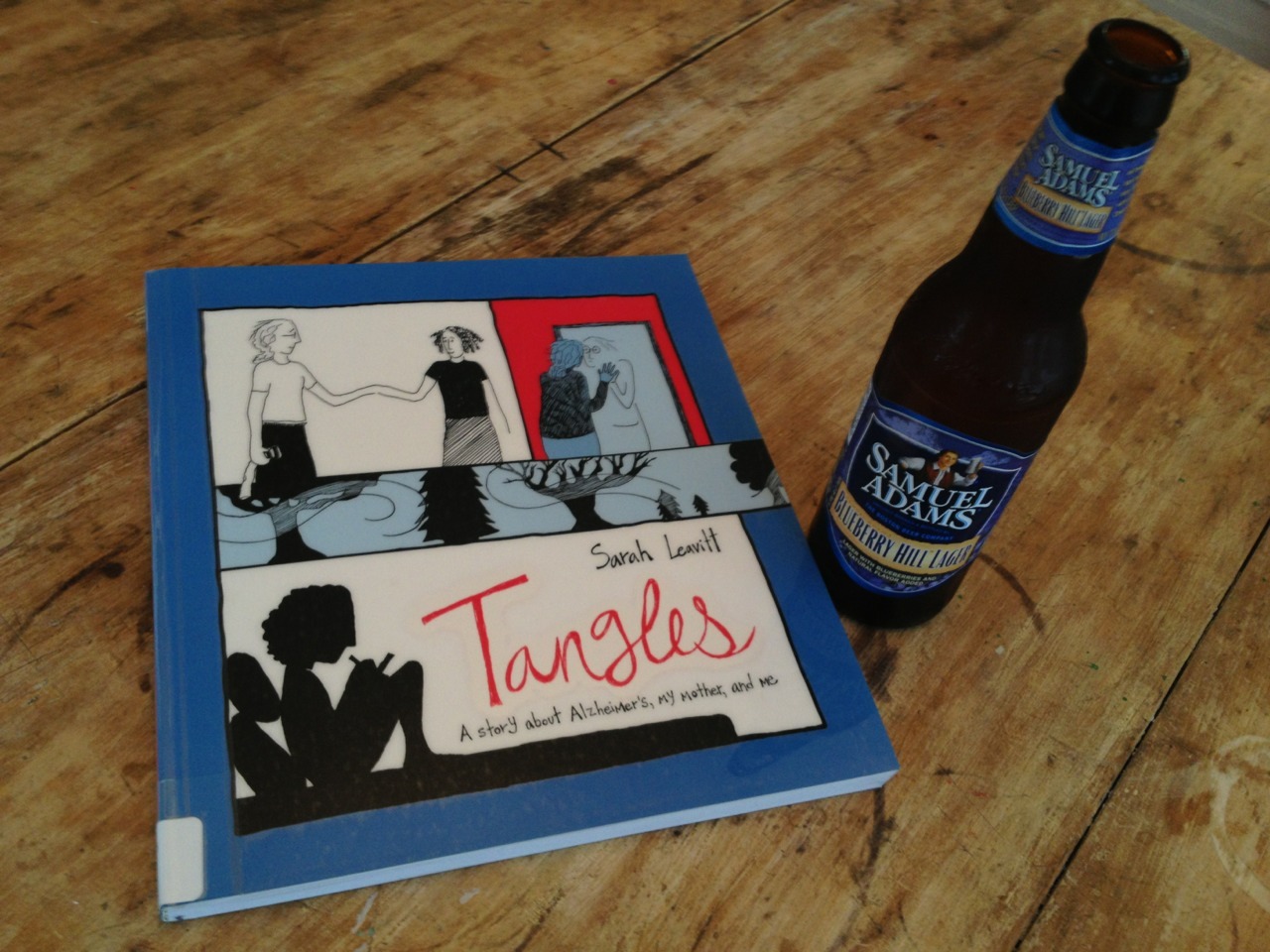
Review: Tangles, by Sarah Leavitt

This is a very brave book. In Tangles, Sarah Leavitt recounts how her family lived with, dealt with, and was changed by her mother Midge's early-onset Alzheimer's (she began showing symptoms at only 52 years of age). We see an entire family coming to terms with this terrible illness, all in different ways, yet always out of love. It's not a guidebook for how to deal with Alzheimer's (how could it be?), but it is a record of what can be done, what might be done, and (only a couple of times) what perhaps shouldn't be done.

Tangles is simply awash in tiny details, thanks to Leavitt's coping mechanism of recording, in words and pictures, hundreds (thousands?) of observations of--and quotations from--her rapidly changing mother. The book's first-person narration of these tiny details seems to beg the question, Was this person who talked to broccoli still the mother who raised my sisters and I, the woman so engaged in education, the wife so loving and loved? The answer seems to be "Yes and no," of course. There's still a core of the Midge that we're introduced to in the book's preliminary, historical sections, but there's also a new person, one who sings to herself (no longer with her sisters) while being bathed or who writes ungrammatical notes to her daughter.

As a cartoonist, Leavitt draws in an unadorned, highly simple--even simplistic--style. I at first thought the style too simple but eventually recognized it as direct and honest. The book is a chronicle of Leavitt's feelings and impressions as much as it is a record of specific events, and I think a more highly rendered style would only serve to fetishize the events and overpower her impressions.

The book's large, square pages are generally constructed of five tiers of gutterless panels, leading to a dense reading experience; a lot happens on each page, and Sarah, our narrator, is often at a loss in trying to make sense of it all. How can you make sense of that which so often, by definition, is nonsensical? Such as the note from Midge to Leavitt's partner Donimo, which Leavitt reproduces, isolated in the corner of an otherwise blank page: "Love to Donimo / Hope you like Bmdows. / See you soon / family is / The whole / eags to see you / from Midge" (page 69).

The book is peppered with such large, nearly empty pages, falling in between some of the short, dense chapters. They often highlight quotations from Midge, or simple, striking moments: Actions divorced from time and context, much like Midge's perception of the world around her. Because it is so honest, Tangles is sometimes not an easy book to read. But it is a powerful one.


Tangles: A Story about Alzheimer's, My Mother, and Me
by Sarah Leavitt
Skyhorse Publishing, 2012
ISBN-10: 1616086394
ISBN-13: 978-1616086398
128 pages, $14.95


Thursday, June 6, 2013

Review: Moby Dick (Cozy Classics) by Jack & Holman Wang

Boardbook
Adaptation
Literature
Twelve:
     Words
     Photos
Art
Needle-Felt
Clever
Beautiful
Genius
(website)

Cozy Classics: Moby Dick
by Jack & Holman Wang
Simply Read Books, 2012
ISBN-10: 1927018110
ISBN-13: 978-1927018118
24 pages, $9.95