Showing posts with label New York. Show all posts

Monday, May 27, 2013

Review: Bluebird, by Bob Staake

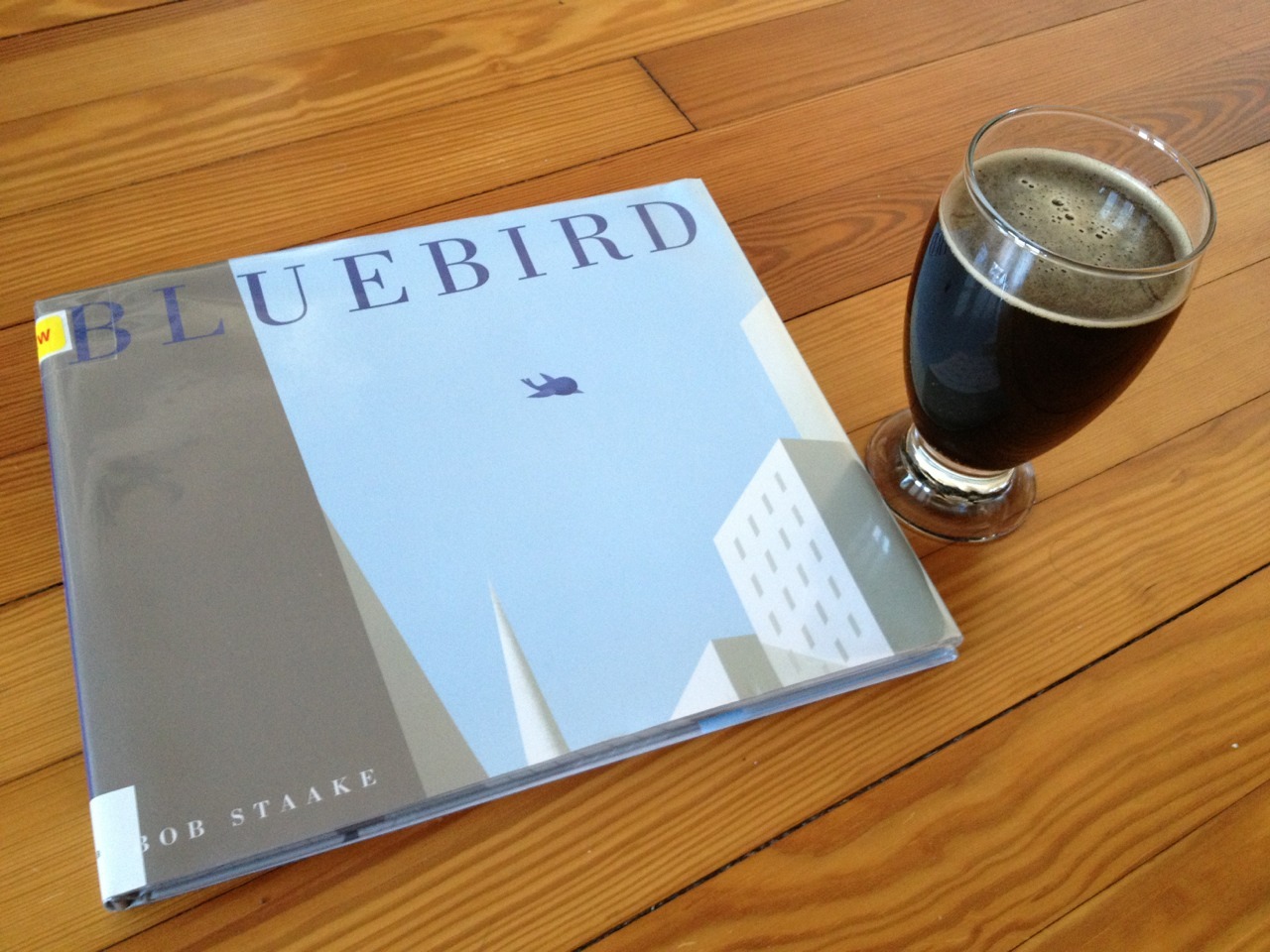
Bluebird, the new wordless picturebook by Bob Staake, is, quite simply, gorgeous. It tells the relatively simple story of a lonely New York City boy who meets and has his life changed by a bluebird. It's a tale of sadness, friendship, loss, and renewal, presented in comics-style, multi-panel pages colored primarily in blues, greys, and white.

Staake's geometric style ("rendered," as the indicia informs us, "in Adobe Photoshop") seems at first glance as if it might be cold; but, as anyone familiar with his other books or his illustration work for The New Yorker and elsewhere already knows, his spheres and boxes and cones are capable of conveying and creating deeply emotional scenes, from the little boy's downcast eyes and defeated posture in the book's beginning; to the wonder of the city's architecture, both grand and mundane; to the threatening moments in the woods of the park; to the freedom and exhilaration of the skies. Rarely have such simple shapes seemed so full of life.

Wordless (or "silent") books of course rarely have no words at all; while these pages don't offer narration or dialogue, we can still see words on signs or on classroom blackboards. And Staake's backgrounds are always worth exploring. Young eyes will have a lot to take in once they've devoured the main plot. I particularly liked the poster on the classroom wall which hearkens back to Staake's dedication in the front of the book.

The publication design here is elegant. Picturebooks often provide immersive book experiences like this for their young readers, and Bluebird is no different: The story actually begins on the front cover, where we meet the bluebird and then follow its flight across the city over the course of the front endpapers and then the indicia and title pages.

At turns melancholic and joyous, but always lyrical, Bob Staake's Bluebird belongs on the bookshelf of every child who's ever felt alone in or confused by the world around them--which is to say, of course, all children, current and former.

Bluebird
by Bob Staake
Schwartz & Wade, 2013
ISBN-10: 0375870377
ISBN-13: 978-0375870378
40 pages, $17.99
Monday, March 18, 2013

Review: Vivian Maier: Out of the Shadows, by Richard Cahan and Michael Williams

It's an unfortunate if oft-repeated scenario: An artist goes unrecognized in his or her lifetime, only to have their work discovered and fêted too late for acclaim or riches. Such is the story of Vivian Maier, who spent her formative years in France, then worked as a nanny for a series of families in the United States, mostly in the Chicago area (for a brief stint, she even worked for Phil Donahue). She always carried a camera, but she never allowed anyone to see her photographs, and by all accounts she lived an extremely private life. So, her genius was never known while she lived. Her work was only discovered when her belongings were auctioned off, and someone who won a container full of undeveloped film examined the contents and discovered Art.

I first learned of her work thanks to a Facebook friend posting a link to the trailer for an upcoming documentary about Maier's life and work. I'm so glad that I took the 2-1/2 minutes to watch that video:


Maier's life story is intriguing, yes, full of secrets and mysteries. But her photographs are magical in their honesty and beauty. Vivian Maier: Out of the Shadows by Richard Cahan and Michael Williams provides a wonderful introduction to the artist and her art. After a brief biographical introduction, the bulk of the book is given over to chapters highlighting different aspects of her photography, beginning with snapshots from France and then delving into her chronicles of America in the 1950s and 1960s. (She continued photographing her surroundings well into the 1990s, apparently, and in color, too; but this book focuses on her '50s and '60s black-and-white work.)

She was not afraid to visit, regularly, the toughest, most run-down areas of Chicago, her young charges in tow, to photograph anyone she felt worthy of capturing. The humanity and dignity of her subjects, even those skid-row denizens whom most people might cross the street to avoid, come across vividly in her portraits. Some of these photos seem somewhat posed or at least contemplated, while others were obviously taken on the sly.

Amazingly, Maier almost never took multiple shots of the same subject (apart from the children in her care, and a series of pensive self-portraits, sometimes just of her own shadow): One carefully considered image was enough for her. And the results are stunning. The year 1968 was particularly pivotal for America, and indeed for Maier; there's a whole chapter devoted to her chronicles of that tumultuous time, with special attention paid to the life and death of Robert F. Kennedy. While I loved all of the images in the book, my favorites are the portraits in the chapter "Downtown" (pp. 206-241). Here are young people and old people; the rich, the poor, and the once-rich; characters all. These are only single portraits, but I feel as if I can see into these people's souls; the good and the sad are revealed in equal measure.

For all of the hundreds of images in this book, I realize that this collection only scratches the surface; I look forward to finding more of them to marvel at.

Vivian Maier: Out of the Shadows
by Richard Cahan and Michael Williams
CityFiles Press, 2012
ISBN-10: 0978545095
ISBN-13: 978-0978545093
288 pages, $60.00

Sunday, January 27, 2013

Review: After the Fall, by Victoria Roberts

If you're even a casual reader of The New Yorker, you're familiar with the cartoons of Victoria Roberts: They usually feature a prominently-beschnozzed couple quipping about some facet of modern urban life. They're almost the prototypical New Yorker cartoons, except that they skew towards the absurd juuuuuust a bit in a way that no one else's manage to do. I was lucky enough to get to meet Roberts at the Ohio State University Festival of Cartoon Art in 1998, where she was one of the guests. As you might expect, she was as funny and engaging in person as she is in print, and personable, to boot.

So I was excited when I learned that she had recently published an illustrated novel, After the Fall. It's the tale of a quirky Manhattan family (the father's an inventor, the mother's a socialite from Buenos Ares, and the children are precocious) who lose their penthouse and are forced to live in Central Park, cut off from (most of) their creature comforts and needing to survive by wits and charity.

I generally enjoyed the story, although it is very slight. This is a small book, and there are at least one or two illustrations on all but maybe three pages. If you removed the illustrations, the remaining text would make for a fairly short story, so if you're looking forward to luxuriating in a novel's prose, this is not the book for you. While Roberts definitely can turn a phrase with élan, the book's prose is nonetheless somewhat too sketchy for my taste. It reads like something between an urban folktale and a story pitch, with the latter dominating quite a bit. There are great small bits throughout, but I found myself wishing there were more meat on these narrative bones.

The black and white cartoon image are charming and playful, as you'd expect from Roberts' New Yorker work and as the tale demands. While they sometimes act as straightforward illustrations, simply replicating a scene or idea that the text has already described, there are plenty of instances where the images expand on the text in interesting ways. For example, when the narration by Alex (the son) states that "It was more disconcerting than anything else to have our parents get along so well" (82), the facing-page illustration shows Mother and Pops engaged in a game of Twister (with a squirrel holding up the spinner board); the parents are fully clothed (Mother in her turtleneck and slacks, Pops in his bathrobe and matching pajamas), but the pose manages to be simultaneously clearly joyful and also slightly suggestive, making the children's discomfort at their parents' happiness understandable.

Such text/image richness does help to flesh out the story beyond the somewhat bare-bones prose, but it isn't done consistently or dynamically enough to really develop the narrative in ways that justify calling the book a "novel." It's an whimsically entertaining, illustrated short story. Perhaps that is enough.

And, a side note to whoever created After the Fall's Library of Congress Cataloging-in-Publication Data: Just because a book contains cartoon images, that does not make it a "graphic novel." This is yet another example of why I dislike the term "graphic novel": Its over- and misuse as a marketing term has rendered it almost utterly meaningless. After the Fall is no more a graphic novel than are the Diary of a Wimpy Kid books - and those books, at least, sometimes contain brief comics narratives (panel-to-panel storytelling, word balloons). Have we really reached a point where publishers are more comfortable calling an illustrated book for adults a "graphic novel" than they are calling it a "story with pictures"? If so, that is a sorry state of affairs.

After the Fall: A Novel
by Victoria Roberts
W. W. Norton & Company, 2012
ISBN-10: 0393073556
ISBN-13: 978-0393073553
188 pages, $24.95

Tuesday, November 20, 2012

Review: Unterzakhn, by Leela Corman

Esther and Fanya are twin sisters and first-generation Jewish Americans growing up on the Lower East Side of New York City in the early 20th Century in Leela Corman's graphic novel Unterzakhn ("underthings"). We follow the girls from around age six well into adulthood, tracing their very different but intertwined life paths: Fanya takes a job with a female doctor who specializes in women's health, while Esther works in a burlesque house / bordello before establishing herself in New York's arts scene. With set-ups like that, you might guess that events take dark, adult turns, and you wouldn't be wrong. Some of the story points teeter towards the melodramatic, but they're nevertheless convincing and compelling. Flashbacks to the twins' father's youth in Europe show a different sort of grasping at life's opportunities and viscitudes -- rural, not urban like the girls' -- but together these life portraits bring the past, a specific past, to life.

Corman's art, always accomplished, here takes on an almost velvety texture. The drawing on the first twenty five or so pages is tighter, more delicate and controlled than the rest of the book; but after that things tend to get looser, with ink lines growing bolder, more gestural, lusher. (Hair in particular becomes an occasion for artistic abandon.) The settings are richly defined -- Corman's research doesn't hit you over the head, but it informs every page, every panel. These are lived-in environments, detailed and believable.

Unterzakhn is a book about choices and circumstance, adversity and love. It's not always an easy read, but it's a valuable one. 

Unterzakhn
by Leela Corman
Schocken Books, 2012
ISBN-10: 0805242597
ISBN-13: 978-0805242591

208 pages, $24.95