Tuesday, July 16, 2013

Review: The Monsters' Monster, by Patrick McDonnell

Patrick McDonnell, the cartoonist behind the already-classic comic strip Mutts, has created a picturebook about monsters whose bad behaviors are very much like those of this book's potential audience. "Who could complain the loudest? Who could throw the most terrible tantrum? Who was the most miserable?" Their most fiendish plot of all involves creating another monster, one whom they hope will be the most terrifying of all. But this Monster (a chunky, cartoonified version of Boris Karloff's portrayal of the Frankenstein monster) has other ideas. I won't give it all away, but I will note that jelly donuts play a part.

McDonnell's artwork is, as always, loose and playful and highly expressive. Little two-headed Gloom 'n' Doom is especially hilarious to watch throughout. The text is clever and a bit sing-songy in places, perfect for reading aloud. And the book's gentle lesson will warm the heart of any little (or big) monster.

"Dank you," Patrick McDonnell.

The Monster's Monster
by Patrick McDonnell
Lttle, Brown, 2012
ISBN-10: 0316045470
ISBN-13: 978-0316045476
40 pages, $16.99

Monday, July 1, 2013

Review: Black Paths, by David B.

David B. is one of my favorite cartoonists: His lush drawings brim over with bold design work, mythological references, and symbolic energy. Epileptic, his account of growing up with a brother who suffered from grand mal seizures and his family's attempts to cope with the situation, remains one of the finest non-fiction graphic novels I've ever read. My French is very poor, but back when I had access to French-language comics I would buy anything with his name on it, just to luxuriate in his imagery, even when my understanding of his verbal nuances was lacking.

Black Paths is a fictionalized account of the Free State of Fiume after the First World War, told mostly through the eyes of Lauriano, a young writer who suffers from his experiences in WWI, and Mina, a French cabaret singer. The book is utterly beautiful: B.'s artwork sings with the addition of color (most of his earlier work I'd encountered was in black and white only), and--as usual for him but unusually for most cartoonists--there are many passages where impressionistic images and non-standard design and layout create beautifully dream-like moments.

However, the ins and outs of political intrigue have never held much appeal to me, and such matters are the meat of this book. Perhaps I simply wasn't in the right mood when I read it, but I could never seem to connect with the narrative in a meaningful way. I am convinced that the fault lies with me, not with the cartoonist, though. One day I'll give this book another chance, which it deserves. It's a bravura exercise in cartooning, but on a subject matter I couldn't seem to relate to. This time.

Black Paths
by David B.
Self Made Hero, 2011
ISBN-10: 190683833X
ISBN-13: 978-1906838331
128 pages, $24.95

Tuesday, June 25, 2013

Review: Spider-Men, by Brian Michael Bendis and Sara Pichelli et al.

The reason this book exists is the very reason that so many people find it hard to "get" superhero comics. Briefly? There's another "Marvel Universe"* outside the regular one with all the heroes you probably know (from the movies if nowhere else**). This "Ultimate universe" has the same heroes, mostly, although with sometimes subtle, other times profound differences. Perhaps the biggest difference is that "Ultimate" Spider-Man--a youthful Peter Parker--died. In the Ultimate universe, at least so far, dead means dead (unlike the regular Marvel Universe, where people die and come back to life over and over, like clockwork). But before too long, Miles Morales, a thirteen-year-old mixed-race youth, gained spider-powers and assumed the mantle of Spider-Man. These two universes existed side-by-side on the comics store shelves for a dozen years, but until Spider-Men, there had never been a cross-over story bringing them together.

If you're confused, you probably don't read superhero comics all that regularly. And therefore, Spider-Men might not be the book for you to start with. Writer Brian Michael Bendis (who's scribed Ultimate Spider-Man from day one) does his best to set the stage(s) for this event: we get a very clear idea of who Peter Parker is, and a somewhat less-clear but still revealing portrait of Miles Morales. The first chapter opens with a several-page monologue by Peter/Spider-Man about why he loves New York City; once Peter gets transported to the Ultimate universe and Miles shows up, we see how the young hero is slowly fitting into the super-fabric of his own version of the city.

But the heart of the book--and I do mean heart--lies in the meeting, mid-point in the narrative, between "our" Peter Parker and the Ultimate versions of Peter's Aunt May May and Gwen Stacy (who, in our universe, was Peter's girlfriend until she was killed at the hands of the Green Goblin, in one of the most momentous story lines in the character's history--a death which haunts him only second to that of his Uncle Ben). Clearly, beyond the hook of the first cross-over between these universes, what writer Bendis is most interested in is these characters.

At first, May and Gwen--like everyone else--chides this adult Spider-Man for dressing up in the dead Parker's costume (his identity having been revealed to the world at his death). Once Peter unmasks and, predictably, May faints at the knowledge that her beloved nephew (at least a version of him) is alive and in her life again, the three characters have a lengthy conversation, which moves from tentative outreach and regret to gradual acceptance and, eventually, a kind of joy.

It's pure soap opera. But then, that's really what superhero comics are, when they work well. The costumes and powers and fights are part of the genre, of course, but the serial nature of superhero comic book storytelling has relied on the emotional histrionics of soap opera since at least the birth of the so-called Marvel Age of Comics in the 1960s. Writer Stan Lee and artist Jack Kirby's Fantastic Four began the trend, but Lee and artist Steve Ditko's Amazing Spider-Man arguably perfected the formula. Bendis and Ultimate Spider-Man artist Sara Pichelli show a lot of comfort working in larger-than-life, character-based psychodrama here.

Pichelli's artwork is lean and clean and very much what good super-hero comic art looks like now, with detailed environments and some very nicely exaggerated spider-poses on our eponymous heroes. But if anything, her depiction of facial expressions is a bit restrained--which would be fine in a literary slice-of-life comic, but super-soap gives you a license to kick up the histrionics. Still, that's a small quibble. I prefer my cartooning a bit more expressive and abstracted (see: Ditko and Kirby again), but as contemporary superhero art goes, this is fine stuff. Layouts are varied but always readable, moving the story forward without much in the way of flashy distractions.

I haven't talked much about the plot or the villain here. But really, beyond the fact that Spider-Man goes to the Ultimate Universe*** and meets not only his replacement but also several other heroes, the plot's incidental to the character interactions. If you haven't read many superhero comics--particularly Spider-Man comics--the character stakes might not mean all that much to you. (Again, serial storytelling means that you get to know these characters in depth; a small verbal aside here can feel freighted with import if you've followed the characters beforehand.) But for regular Spider-Man readers, Spider-Men provides a dose of emotion and a bit of wonder. And Peter's mysterious discovery at the very end ensures that there will be more where this story came from, in some other fashion.

*Actually, there are an infinite number of them, but I'm trying to keep this simple...

**Although the Marvel movies often conflate the "original" and "ultimate" versions of these heroes...

***Where everyone talks in a mixed-case typeface, unlike the all-caps "regular" universe. No, there's no particular reason I placed this footnote in this sentence; I just wanted to shoehorn in a font-nerd reference somewhere...


Spider-Men
by Brian Michael Bendis and Sara Pichelli et al.
Marvel, 2012
ISBN-10: 0785165339
ISBN-13: 978-0785165330
128 pages, $24.99

Wednesday, June 19, 2013

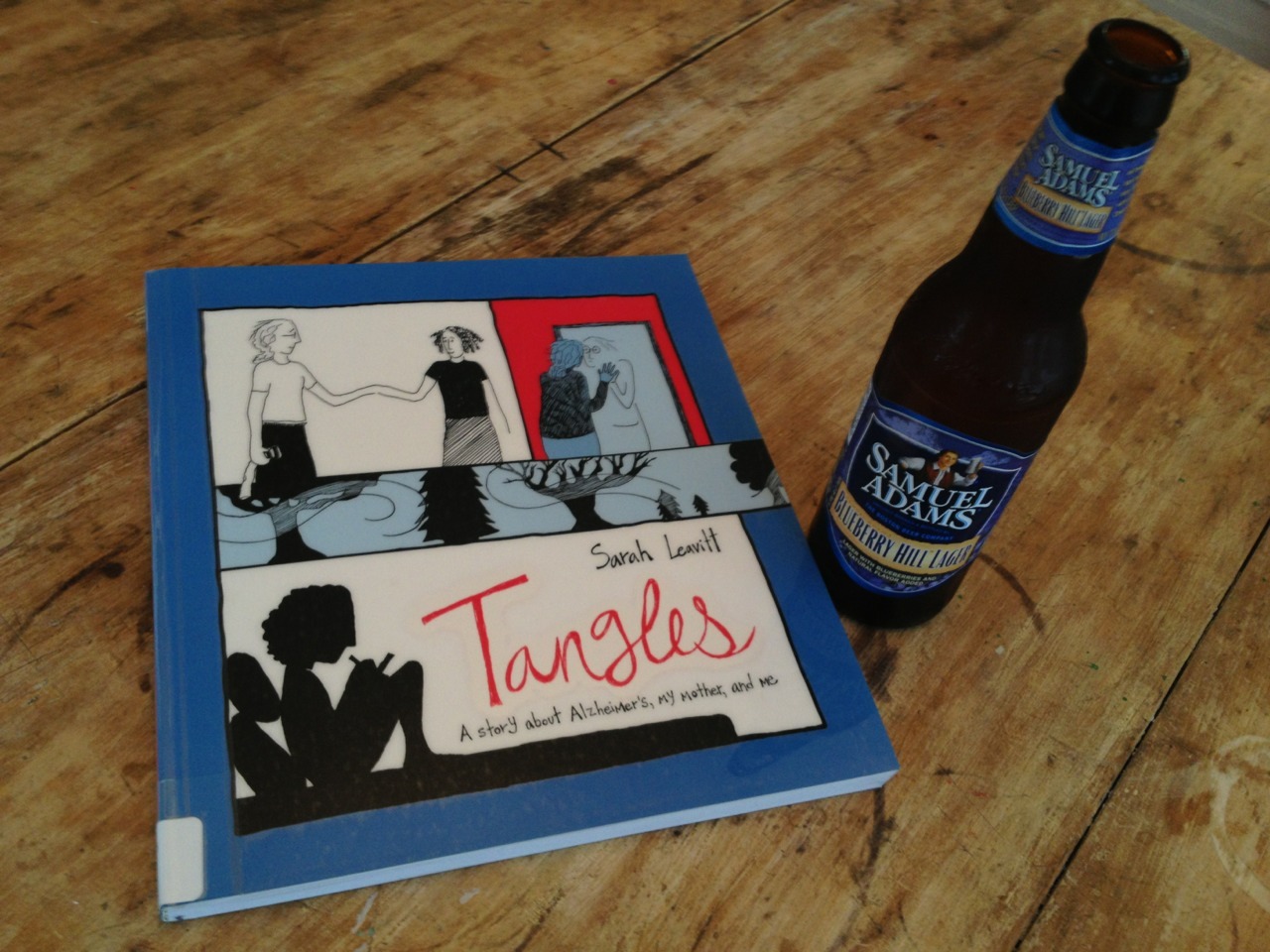
Review: Tangles, by Sarah Leavitt

This is a very brave book. In Tangles, Sarah Leavitt recounts how her family lived with, dealt with, and was changed by her mother Midge's early-onset Alzheimer's (she began showing symptoms at only 52 years of age). We see an entire family coming to terms with this terrible illness, all in different ways, yet always out of love. It's not a guidebook for how to deal with Alzheimer's (how could it be?), but it is a record of what can be done, what might be done, and (only a couple of times) what perhaps shouldn't be done.

Tangles is simply awash in tiny details, thanks to Leavitt's coping mechanism of recording, in words and pictures, hundreds (thousands?) of observations of--and quotations from--her rapidly changing mother. The book's first-person narration of these tiny details seems to beg the question, Was this person who talked to broccoli still the mother who raised my sisters and I, the woman so engaged in education, the wife so loving and loved? The answer seems to be "Yes and no," of course. There's still a core of the Midge that we're introduced to in the book's preliminary, historical sections, but there's also a new person, one who sings to herself (no longer with her sisters) while being bathed or who writes ungrammatical notes to her daughter.

As a cartoonist, Leavitt draws in an unadorned, highly simple--even simplistic--style. I at first thought the style too simple but eventually recognized it as direct and honest. The book is a chronicle of Leavitt's feelings and impressions as much as it is a record of specific events, and I think a more highly rendered style would only serve to fetishize the events and overpower her impressions.

The book's large, square pages are generally constructed of five tiers of gutterless panels, leading to a dense reading experience; a lot happens on each page, and Sarah, our narrator, is often at a loss in trying to make sense of it all. How can you make sense of that which so often, by definition, is nonsensical? Such as the note from Midge to Leavitt's partner Donimo, which Leavitt reproduces, isolated in the corner of an otherwise blank page: "Love to Donimo / Hope you like Bmdows. / See you soon / family is / The whole / eags to see you / from Midge" (page 69).

The book is peppered with such large, nearly empty pages, falling in between some of the short, dense chapters. They often highlight quotations from Midge, or simple, striking moments: Actions divorced from time and context, much like Midge's perception of the world around her. Because it is so honest, Tangles is sometimes not an easy book to read. But it is a powerful one.


Tangles: A Story about Alzheimer's, My Mother, and Me
by Sarah Leavitt
Skyhorse Publishing, 2012
ISBN-10: 1616086394
ISBN-13: 978-1616086398
128 pages, $14.95


Thursday, June 6, 2013

Review: Moby Dick (Cozy Classics) by Jack & Holman Wang

Boardbook
Adaptation
Literature
Twelve:
     Words
     Photos
Art
Needle-Felt
Clever
Beautiful
Genius
(website)

Cozy Classics: Moby Dick
by Jack & Holman Wang
Simply Read Books, 2012
ISBN-10: 1927018110
ISBN-13: 978-1927018118
24 pages, $9.95

Monday, June 3, 2013

Review: Daredevil by Mark Waid vols 1 & 2, by Waid, Rivera, Martin, Rios, Kano, Pham et al.

I haven't read a new Daredevil comic book in many years, but I've heard enough about them to know that the character had been put through the wringer time and again, and that the title was known for being psychologically dark. Daredevil's secret identity as blind lawyer Matt Murdock had been made public (more than once?); he had become crime lord of New York (I think); he had been replaced by The Black Panther. In other words, typical high-impact superhero soap opera, though even grittier and more morally ambiguous than most.

But when Marvel Comics re-launched the title (yet again!) in 2011, it was announced that the character was headed in a new direction--or, should I say "old," for this new series, under writer Mark Waid, would be a return to the character's "lighthearted acrobat" roots, albeit one that would somehow not wipe away the character's more recent dark developments. Intrigued, I picked up the first two collected volumes from the library. What I found was a solid superhero comic, often visually innovative, which did indeed rekindle the sense of adventure and fun I recall from my own childhood reading of the character.

The gist of writer Waid's approach is that Murdock has survived being put through hell, and his coping mechanism is to treat life as a laugh (mostly--he is still a lawyer and crime-fighter, after all). While his secret identity was made public, the public's reaction to news is fickle, so while some people still believe that Murdock is Daredevil, others are unsure. Matt sometimes wears an "I'm Not Daredevil" shirt to deflect suspicion (though why that wouldn't just reconfirm said suspicion isn't exactly clear). His reputation makes it difficult for any clients he or his partner Foggy Nelson represent to get a fair trial, so he comes up with a new tactic: Their law firm will take on clients whom no one will represent and then coach them how to act as their own counsel, thereby allowing them to go to court without the distraction of all the "Daredevil" innuendos that follow Murdock wherever he goes. It's a narrative conceit that is as clever as it is utterly ridiculous; thankfully there's enough super-action that we don't see too, too many of these cases.

The artwork is in keeping with this lighter narrative approach. Particularly in the case of artist Paolo Rivera, we get characters composed of clean lines (if often a bit stiff in the staging) and innovative, almost bouncy page layouts. There are some new tricks to represent Daredevil's "radar sense" (often red contour lines over black backgrounds, as well as tiny inset panels which draw our attention to small details, highlighting Murdock's own heightened view of the world) as well. Even Rivera's cover to the first collection (which was also the cover to the first new issue) plays with how Daredevil exists in a world without vision: everything in the background environment is composed of words, representing how his brain "molds" objects out of sound. Examples: birds are built out of the words "flap flap flap," a water tower out of "glug gurgle drip drop," exhaust out of "hsssss." And Daredevil holds one of his billy clubs directly in front of his eyes, emphasizing for the reader the character's sightlessness.

The stories also work thematically with the character's attributes, pitting him against adversaries like Klaw (a being composed of solidified sound) and the nearly blind Mole Man--both, I think, for the first time. He also teams up with Spider-Man (a character with whom he has a long history) and hooks up with The Black Cat (a morally grey acrobat herself). And the macguffin of the OmegaDrive (a quantum hard drive containing information on several crime families and syndicates) ensures that Daredevil is never far from a tussle with any one of Marvel's many mafia surrogates.

All in all, these are solid, well-crafted superhero stories, light-hearted (usually) but not light-weight.

Daredevil by Mark Waid vol. 1
by Mark Waid, Paolo Rivera, Marcos Martin et al.
Marvel, 2012
ISBN-10: 0785152385
ISBN-13: 978-0785152385
152 pages, $15.99

Daredevil by Mark Waid vol. 2
by Mark Waid, Paolo Rivera, Emma Rios, Kano, Khoi Pham et al.
Marvel, 2012
ISBN-10: 0785152407
ISBN-13: 978-0785152408
136 pages, $15.99

Wednesday, May 29, 2013

Review: Springsteen on Springsteen: Interviews, Speeches, and Encounters, ed. Jeff Burger

I first saw Bruce Springsteen and the E Street Band perform in 1985 at Soldier Field in Chicago (I had won the tickets from a radio call-in contest), the second year (second year!) of the Born in the U.S.A. tour. The stage was in the football field's end zone, and in my memory, my friend from high school Jim and I were standing on about the 20-yard line at the stage-end of the field, although now I can't believe we actually managed to get anywhere near that close. Wherever we were standing (standing, for three-plus hours), I could see things pretty well, given my height and the presence of huge video screens. Even though by that point the band was playing ten of the new album's twelve songs, eschewing some older classics (where oh where was "Rosalita (Come Out Tonight)"?), it was still an amazing, life-enriching show for me, and for the probably 60,000 other people in attendance.

1985. 60,000 people.

Here's Springsteen in an unpublished interview from 1974, eleven years prior:
Usually we won't play anyplace over three thousand [people]--that's the highest we want to do. We don't want to get any bigger. And that's even too big....
P[aul] W[illiams]: But then there's The Who. They announce they're playing Madison Square Garden and it sells out in an hour. So I guess they'd have to book a week, a whole week.
BS: You gotta do that. And if you get that big, you gotta realize that some people who wanna see you ain't gonna see you. I'm not in that position and I don't know if I'll ever be in that position. All I know is those big coliseums ain't where it's supposed to be. There's always something else going on all over the room....
PW: I guess people go for the event.
BS: What happens is you go to those places and it turns into something else that it ain't. It becomes an event. It's hard to play. That's where everybody is playing, though, I don't know how they do it. I don't know what people expect you to do in a place like that. Especially our band--it would be impossible to reach out there the way we try to do. Forget it! (pages 34-35)
But Bruce and the band not only fairly soon managed "the impossible"; they became the undisputed, three-hour-plus masters of it, and have remained there for close to four decades.

In Springsteen on Springsteen, editor Jeff Burger allows us to see how Bruce was able to develop from a pretty inarticulate but hungry young artist into one of rock's elder statesmen and most eloquent spokespersons. Burger has gathered interviews, speeches, and more, ranging from a profile from 1973 to Springsteen's keynote address to the South by Southwest Music Festival in 2012. (The book is also peppered with "Bruce Bits," snippets of other interviews that touch on ideas not covered in the full-length pieces.) I've read several books about Springsteen in the past couple of years (most recently Bruce by Peter Ames Carlin), and each have their strengths, but this one does a wonderful job of demonstrating Springsteen's ever-evolving sense of himself as an artist.

His early interviews reveal an incredibly prodigious songwriter who was nevertheless very cautious--even guarded--when it came to how much of his music he presented his music to the public. Later in life, though, he began opening his vaults, beginning with the four-disc set Tracks (1998). There was evidence of this shift in perspective a few years before that, though, such as in this Guitar World interview with Neil Strauss in 1995:
Certainly, I go back and realize that there are many outtakes that should have been released at different times. I still wish I'd put more records out, and maybe I could have. But I made records very purposefully, with very specific ideas of them being about  and representing certain things. That probably caused me to be overly cautious about what I released and what I didn't. I certainly feel a lot more freedom now. (page 200)
It becomes clear when reading the earlier pieces that the feeling of freedom he felt in the 90s came for him only after consciously and meticulously shaping his early career along specific thematic lines.

And for a performer who's now known for his political activism, appearing on behalf of politicians like John Kerry and Barack Obama, he was for a long time reticent to espouse any overtly political rhetoric, although his populist sympathies generally weren't hard to spot in his lyrics. Even in the 1990s, an invitation from then-President Bill Clinton wasn't enough to tempt him, as David Corn inquired in a Mother Jones interview (1996):
DC: The White House wanted you to drop by today, but you chose not to.
BS: What ears this man has! [Laughs.] I don't know what to say. In my opinion, the artist has to keep his distance. (page 217)
Springsteen seems to have avoided many sorts of temptation. Unlike just about every other rock or pop musician you can think of, he never fell prey to the dangers of chemical addiction. Indeed, several early reviews make a point to mention his tea-totaling ways. By the 1990s, though, interviewers occasionally set the set the scene for their pieces with tales of Springsteen offering to share some beer or Jack Daniels, drinks which the performer then barely touches (if at all) for the duration of the interview. Gavin Martin, from the New Musical Express, brought up the subject of drugs in 1996, and Springsteen replied:
I've had a funny experience in that I didn't so any drugs; I've never done any drugs. It's not about having any moral point of view about drugs whatsoever--I know nothing about them.... I didn't trust myself into putting myself that far out of control. I had a fear of my own internal life....
 I was 'round very many people who did many drugs and I can't particularly say I liked any of them when they were stoned or high, for the most part. Either they were being a pain in the ass or incomprehensible. That's my experience--so it didn't interest me.
Also, at a very young age, I became very focused on music and experienced a certain sort of ecstasy, actually, through playing. It was just something I loved doing. (page 225)
One of the strengths of this book is that editor Burger didn't just collect old interviews; he also contacted the interviewers and asked for any background stories or years-later comments they might have. One good example is the introduction to Springsteen's Advocate interview with editor-in-chief Judy Weider (1996). In comments to Burger, Weider placed Bruce's rhetoric in a specific political and personal context:
"Probably the most significant contribution made by Bruce in the interview (aside from revealing his own struggle with how he'd really feel if one of his own children turned out to be gay) came when e discussed marriage for LGBTs. It is important to remember that this was 1996; I had the heads of our own gay organizations cautioning me not to push for marriage. 'Civil unions are enough for now. People are not ready.' It drove me nuts. But Bruce not only understood that was an equal-rights issue, he pushed for gays and lesbians not to settle for less in this interview. His clarity and passion gave me extra backbone for my own ongoing fight over the years: '[Marriage] makes you a part of the social fabric. You get your license; you do all of the rituals.... [It's] a part of your place in society and in some way part of society's acceptance of you.'
"No one has said it better in my view," Wieder concluded. "The world is catching up to Bruce even now." (pages 234-235)
Again, these later pieces demonstrate a sense eloquence that simply wasn't there in the early days. I recall reading a Rolling Stone interview back in 1984 or 1985 (not included in this book) and wondering more than once how someone who could write lyrics with such directness, power, and beauty could so often speak so hesitantly. How could the man whose poetry I admired be so, well, inarticulate so often? This was before I began doing some writing and public speaking myself, before I learned that my own best self came not through extemporaneous speech but through carefully considered and crafted prose. Revision is the key to good writing, and Springsteen has always been a notorious reviser of his lyrics.

As we see over the course of this collection, Springsteen took revision in all forms seriously, and eventually got to the place where he spoke to reporters not hesitantly but thoughtfully and reflectively, with all of the care and craft his lyrics exhibited. Nick Hornby introduced his Observer Music Monthly interview in 2005 in part by noting:
[Springsteen's] answers came in unbroken yet carefully considered streams. He is one of the few artists I've met who is able to talk cogently about what he does without sounding either arrogant or defensively self-deprecating. (page 313)
In an interview with the actor Ed Norton in 2010, Springsteen channels a filmmaker to give one of the best examples I've read of a description of an artist: "Martin Scorsese said the artist's job is you're trying to get the audience to care about your obsessions" (page 354). And later that year on Australian television with interviewer Ian "Molly" Meldrum, he positioned himself as a particular kind of artist: a storyteller.
If you look at the role of storytellers in communities going back to the beginning of time, they played a very functional role in assisting the community and making sense of experience, of the world around them, charting parts of their lives, getting through parts of their lives. I was interested in the eternal role of storyteller and songwriter and how I was gonna perform that function best. (page 369)
The Bruce Springsteen of 1974, at least the public speaker, never mentioned ideas like this. But did he think things like this? The Springsteen of 2010 says he did. Can we gainsay him that? For an artist whose first two albums especially delighted in the play and sound of words, his interviews--his honest, raw declarations "for the record"--took quite a long time to catch up and become lyrical in and of themselves. Perhaps he needed to hone not just his song-craft but his larger word-craft over time. The young Springsteen's speech strikes us as a bit crude and unfinished; the elder man speaks in sharp-edged, purely forged prose.

Springsteen on Springsteen not only traces the career of a songwriter; it chronicles the development of a thinker. As the imagery in his songs became more direct, more focused on the real world than on flights of verbal fancy and epics of escape, Springsteen's inner life blossomed to the point that his everyday speech could speak of hopes and dreams, of aspirations and heartache, with a beauty and a power and a poetry all its own.  In assembling these interviews spanning nearly four decades, Jeff Burger helps us to build a complex, evolving portrait of a performer, of a human being who grew into being the boss of his own mind.

Springsteen on Springsteen:
Interviews, Speeches, and Encounters
ed. Jeff Burger
Chicago Review Press, 2013
ISBN-10: 161374434X
ISBN-13: 978-1613744345
428 pages, $27.95