Sunday, February 1, 2015

Review: The Wonderful Egg, by Dahlov Ipcar

I flipped through this book yesterday at the Flying Eye Books / Nobrow booth at ALA Midwinter. From the appearance of Dahlov Ipcar's delightfully animated dinosaur drawings, it looked like something I might have checked out from the library when I was a child. (It's a re-issue, painstakingly restored, of a book originally published in 1958, so the time period was about right for me to have seen it at a young age, given how long books last in public libraries.) I went back to look at it again today, this time examining it more closely, including the words.

Suddenly it all came back to me. I had read The Wonderful Egg, from the library, many times! "Triceratops was big, too, but not as big as Brontosaurus." BAM! Take that, Proust! So of course I had to buy it. Such beautifully stylized drawings, simple but informative text, and a narrative twist to end it. Plus, at the back, "This is the Way to Say Their Names," which was most probably my introduction on how to pronounce the names of two dozen dinosaur types.

Now I want to read all the rest of the Dahlov Ipcar books that Flying Eye is re-issuing.


By Dahlov Ipcar
Flying Eye Books, 2014 (Doubleday, 1958)
ISBN-10: 1909263281
ISBN-13: 978-1909263284
48pp., $19.95

Monday, October 13, 2014

Review: The Memory of Whiteness, by Kim Stanley Robinson


In The Memory of Whiteness, Kim Stanley Robinson tells the story of Johannes Wright, Ninth Master of Holywelkin's Orchestra (a complex and wonderful assemblage of musical instruments), and his Grand Concert Tour of the Solar System in the 33rd Century. Robbed of his conventional sight by a drug overdose, musician Wright gains a greater insight into the nature of the universe the more he learns about Arthur Holywelkin, the physicist/musician from centuries past who not only created the Orchestra but also articulated the theory of the ten-dimensional universe. These Ten Forms of Change led to the technology enabling the terraforming of most of the planets and moons in the solar system.

Wright is accompanied on this tour by a support staff, including increasingly needed security, and a music journalist who moves from skepticism to respect fairly quickly. They in turn are pursued from planet to planet, moon to moon on the Tour by both Ernst Ekern, Chairman of the Holywelkin Institute's Board and a key figure in a grand, shadowy "meta-drama," and the Greys, a mysterious cult scattered throughout the solar system. These tensions drive the narrative, and they create a satisfying mystery.

But of more interest to me are those moments when Robinson steps back to explore the ineffable nature of music and its relationship to the micro and macro workings of the universe. Indeed, even the history of space colonization is described in musical terms (Allegro; Ritard: moderato; Adagissimo; Intermezzo agitado; Accelerando). When discussing music, Robinson's prose sings (appropriately enough); but as you realize he uses the same style when discussing physics, you come to appreciate what an achievement this novel truly represents.

If I didn't know better, I might think that this was a novel written late in someone's career: It brims over with well-developed ideas and grand themes concerning the laws which govern the universe and how humanity might better understand its place in this grand scheme. This just goes to show why I am not a fiction writer, because The Memory of Whiteness is one of Robinson's earliest novels.

I've enjoyed everything by Kim Stanley Robinson that I've read, with The Mars Trilogy, The Years of Rice and Salt, and Shaman standing as my favorites. The Memory of Whiteness now joins that list.


by Kim Stanley Robinson
Orb Books, 1996 (Tor Books, 1985)
ISBN-10: 0312861435
ISBN-13: 978-0312861438
352 pages, $19.99

Sunday, September 21, 2014

Review: My Pet Book, by Bob Staake


Where was My Pet Book when I was young? It's beautiful, it worships the power of books, and there's lots of fun little bits to discover in the backgrounds of the images, especially in the signs of this pet-obsessed town. "Breed Limit 35"! "Central Bark"! "Bowowery"! (There's even evidence of a voyage to "Funky Town"!)

Bob Staake has become a Jack-of-all-trades when it comes to art (from newspaper illustration to posters to iconic New Yorker covers), but it's clear that he has a special affinity for children's books and the importance of reading. With its rhymed text and colorful, highly stylized (and stylish!) illustrations, My Pet Book will engage and charm you on every page. I can't wait to recommend this "frisky red hardcover" to all the young reading-lovers at my library.

Bonus! Be sure to check out this great, in-depth interview with Bob Staake at the Washington City Paper website, conducted by my good friend Mike "ComicsDC" Rhode

by Bob Staake
Random House, 2014
40 pages, $17.99
ISBN-10: 0385373120
ISBN-13: 978-0385373128

Wednesday, September 3, 2014

Review: CDB! and CDC? by William Steig


One of my favorite books when I was a child was CDB! by William Steig. It was full of black and white drawings, each captioned by a series of letters which, when read aloud, would sound like a phrase or sentence: for example, "CDB!" translates into "See the bee!" Some were pretty straightforward, but some were trickier; the simple, narrative illustrations helped you to decode the captions.

I remember finding the book on a bottom shelf of my neighborhood library. I seem to recall feeling vaguely uneasy about checking it out, as if the book was for "littler kids" than I was (even though I was still very young, myself). After all, I was already reading full sentences, and here was a book that only used letters, not even real words! But I was still fascinated with it, and I've remembered it ever since.

Several months ago, I was amazed to discover that Steig also created a sequel, CDC? I hadn't known about it, but that is probably because it wasn't published until 1984, when I was a high school senior. I requested both books from the library, curious to see what they would be like now, four decades after I first read CDB!

My first shock came with the appearance of the pages. Steig added watercolor to CDB! in 2000, and to CDC? in 2003. So the stark, diagrammatic pictures in my memory here were a bit softer and more gentle. And some of the deciphering was probably just as challenging now as it was when I was a child. I didn't recall there being complex "words," but here they were, especially with names, such as "L-X-&-R." And letters can sometimes sound like different words: S can be either "is" or "yes," depending on context.

Both books are very similar, although CDC?, apart form being about 20 pages longer than its predecessor, contains more grown-up characters, situations, and vocabulary. In one instance, a middle-aged man with a pipe sits and looks at another man, bearded and wild-eyed, who holds bits of a broken chair in his hands. The caption? "M I B-N 2 V-M-N?"

Each book contains, on its final page, an "answer key." I only really needed it once, for an instance in CDC?: what in the world could "D-P" stand for? Turns out it means "dippy." (The slangier the coinages, the more difficult they become to decipher.)

I had a lot of fun re-encountering a childhood friend and meeting its sibling after all this time. They weren't "beneath" me at all. S X-L-R-8-10!

CDB!
by William Steig
Aladdin, 2003
ISBN-10: 0689857063
ISBN-13: 978-0689857065
48 pages, $7.99

CDC?
by William Steig
Square Fish, 2008
ISBN-10: 0312380127
ISBN-13: 978-0312380120
64 pages, $8.99

Review: Neanderthal Man, by Svante Pääbo


A very personal account of the successful attempt to map the genome of a Neanderthal, humanity's closest evolutionary link. Svante Pääbo, the project's lead researcher, necessarily mixes autobiography with procedural descriptions, with his history as a scientist and as a person informing and guiding his quest for what appears at first an impossible goal.

What the non-scientist reader (i.e., me) takes away from this book is a much clearer understanding of the ins and outs of the scientific method. Occasionally Pääbo comes upon a valuable insight through sudden inspiration, but much more often, insight arrives only through teamwork, and only after much trial and error (with a big emphasis on the error). Success in this massive and complex project came only after years of painstaking group effort, characterized by mysteries to solve, blind alleys to back out of, assumptions to re-consider, and techniques to continually refine or, sometimes, abandon.

While my eyes did glaze over at times when the science got extremely detailed, those occasions were few, and probably not Pääbo's fault - even the hard science here is presented carefully and clearly, and I found myself understanding a lot more of the specifics than I had assumed I might. (I soon learned not to bother checking the endnotes, as they consist almost entirely of journal article title references - essential for readers who wish to track the intricacies of each new research development, but they contain no real discursive content. The meat of the book is in the text itself.)

Pääbo does an admirable job of communicating both the substance and the struggle of science; politics and personalities mix with publishing and perseverance. In Neanderthal Man we learn about both an evolutionary cousin and what it takes to do successful science.

Neanderthal Man: In Search of Lost Genomes
by Svante Pääbo

Basic Books, 2014
288 pages, $27.99
ISBN-10: 0465020836
ISBN-13: 978-0465020836


Neanderthal Man: In Search of Lost Genomes by Svante Pääbo,
with a Blueberry Hill Lager from Samuel Adams.


Sunday, February 16, 2014

Review: The Great War, by Joe Sacco, with an essay by Adam Hochschild


With The Great War - July 1, 1916: The First Day of the Battle of the Somme, An Illustrated Panorama, comics journalist Joe Sacco has created a single, 24-foot-long gatefold image which re-creates the events of this day of battle across time and space. Surrounded by two hard covers, the gatefold image comes in a slipcase which also includes a booklet with an author's note and annotations by Sacco, as well as an essay ("July 1, 1916") by historian Adam Hochschild.


Technically, Sacco's image is a tour de force, utilizing shifting perspectives to create the illusion of a single image while also presenting a chronological narrative of the battle's stages. The amount of detail Sacco includes is staggering, including scores--no, hundreds!--of soldiers, and mazes of trenches that seem to go on for miles. Explosions, debris, and devastation abound, and the passage of time allows us to contrast the idyllic pre-battle landscape to the horrific aftermath.

I was intellectually impressed by Sacco's artistic achievement, but it is only Hochschild's essay that really devastates on an emotional level. I already knew that the First World War, that horribly mis-named "War to End All Wars," was a ridiculous waste of human life,;but Hochschild's essay covering the myriad details of this particular battle--the blindly hubristic plans, the utterly devastating results--really drives the point home in ways that not even Sacco's massively detailed panorama can achieve.

The artwork is stunning technically, but without Sacco's annotations and Hochschild's essay, I'm not sure how affecting the end result would be. Actually, I do, and the answer is that it would appeal a lot to my eyes and brain, but much less so to my heart. Sacco's image needed to be a part of this complete package; the panorama alone, impressive as it is, is not enough to drive home the point Sacco strives for. Which he himself acknowledges in his introduction:
Making this illustration wordless made it impossible for me to provide context or add explanations. I had no means of indicting the high command or lauding the sacrifice of the soldiers. It was a relief not to do these things. All I could do was show what happened between the general and the grave, and hope that even after a hundred years the bad taste has not been washed from our mouths. ("On the Great War," Author's Note, p. 2)
Design-wise, The Great War is an impressive package, even if the panorama itself is an unwieldy read (but how could it not be, unless it were mounted along a wall?). One bravura touch it how the book begins and ends. The first image on what would normally be the front endpaper is a close-up drawing by Sacco of the famous Lord Kitchener WWI recruitment poster, followed by the title page; the rest of the book is the panorama itself, which extends all the way to what would normally be the back endpaper. In that final portion of the image, we see soldiers digging and filling graves. So the design leads us rhetorically from heavily romanticized recruitment to the devastating, utter finality of death. The end.

Make war no more!

Tuesday, December 10, 2013

Service Interruption: Use Alternate Route

It's been a few months since I've posted a review here, but that doesn't mean I haven't been reading and reviewing books! It's just that I've been podcasting instead of typing. Many weeks ago I was invited by Derek Royal to sit in for "an episode or two" of The Comics Alternative ("Two guys with PhDs talking about comics!") while his regular co-host Andy Kunka was unavailable. Well, "one or two" episodes soon multiplied, and now, even though Andy is now back in the fold, the Two Guys have invited me to be a permanent addition to the show.

So, to keep up with my verbal comics reviews, along with the interviews that I help conduct with artists and writers, you can follow the Comics Alternative updates I post at my other blog, Comics Research and Such. Or, just subscribe to the Comics Alternative podcast!

And I haven't forgotten about this blog. I have a few non-comics books waiting to be reviewed right now, and I plan to get those up here sooner rather than later.

Happy reading!

Thursday, September 12, 2013

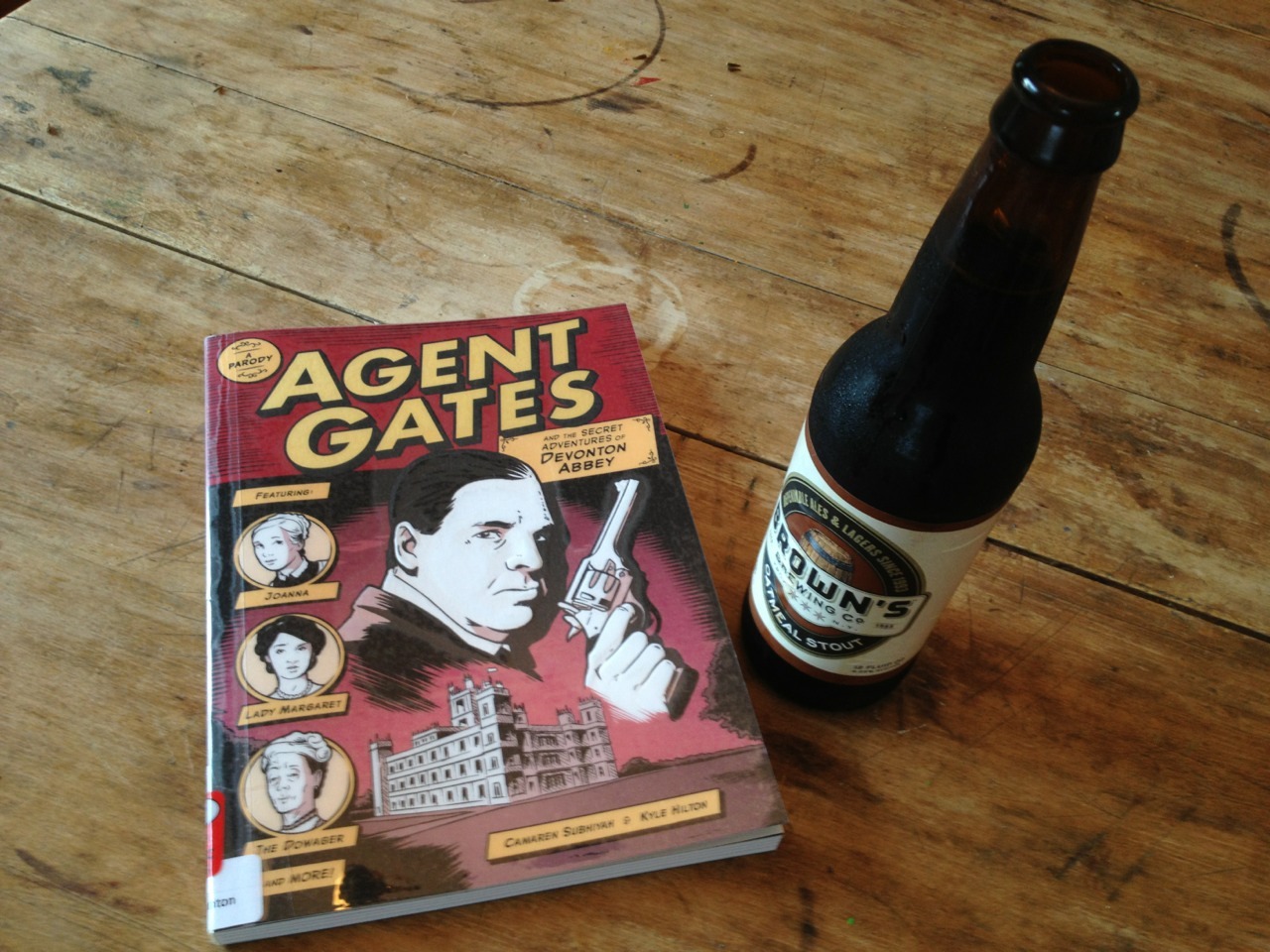
Review: Agent Gates and the Secret Adventures of Devonton Abbey (a parody), by Camaren Subhiyah and Kyle Hilton

It's an intriguing idea for a mash-up: Take the severely reserved characters of the incredibly popular Downton Abbey ITV (and PBS) television series, and re-imagine their story (already tinged with political overtones), changing many of those characters to secret agents. Seems like a can't-miss premise for wacky genre fun, right? And it almost is.

While it's primarily the working-class characters who get to be secret agents, the upper-class characters are almost invariably portrayed as superficial simpletons (Richard Crawhill, Earl of Granville, being the most ridiculous of the ridiculous here). This characterization helps sell the class-conscious narrative, of course, although the parody does descend to some very silly depths. For instance, the inheritance question lying at the center of Downton Abbey here gets an additional wrinkle: if the Crawhills' pregnant dog Sweetsie has a male pup, he will inherit Devonton, and then Lady Margaret won't need to marry Cousin Martin after all. And so on.

Artist Kyle Hilton's character likenesses are usually spot-on, so much so that, except in rare instances, it really does look like you're "watching" a lost episode of the series. Alas, writer Camaren Subhiyah's script isn't content simply to mash-up two genres; instead, it adds strong science-fiction and fantasy aspects to the plot as well, involving elaborate pseudo-scientific gadgetry, the Philosopher's Stone, special mental and physical powers, and more. Oh, and Gates & Co. manage to avert the onset of World War I in the bargain.

It all just seems a bit too over-the-top. The SF aspects threaten to divert the plot too far from parody into, dare I say it, originality. I guess I was looking for something a bit more comfortable in this parody. Agent Gates and the Secret Adventures of Devonton Abbey might have been better served by disguising its Downton-debt and simply telling its original story on its own merits. Although I wonder if it would have been published at all in that case...

Agent Gates and the Secret Adventures of Devonton Abbey (A Parody)
by Camaren Subhiyah and Kyle Hilton
Andrews McMeel 2013
ISBN-10: 1449434347
ISBN-13: 978-1449434342
128 pages, $14.99

Sunday, August 25, 2013

Review: FF vol. 2: The Supremor Seed, by Hickman, Tocchini, Epting, Kitson et al.

Collecting issues #6-11 of the first run of the title FF (which temporarily replaced Fantastic Four), this book continues a cosmic epic begun in who knows which other comics, Fantastic Four or otherwise. Briefly: The Future Foundation (the remnants of the Fantastic Four after the Human Torch has died, plus Spider-Man, plus Dragon-Man, plus Reed Richards' father, plus Reed and Sue's children, plus assorted other younger characters) team up with a bevy of their greatest villains (including Doctor Doom and several others) to stop renegade Reeds from different dimensions from taking over all of everything. At the same time, the Inhumans return from exile. And various mayhems ensue.

Growing up in the 1970s, I always loved the Fantastic Four - I benefited from being able to read the current issues of the title as well as much of the original Stan Lee/Jack Kirby run thanks to the Marvel's Greatest Comics reprint title - and consequently I like to peek in every once in a while to see what's being done with the characters. FF vol. 2 has some interesting moments of characterization, but the plot intricacies rely too heavily on deep continuity knowledge which I don't possess, and which the book itself fails to provide; the Inhumans' storyline in particular is nearly impenetrable, even with an entire issue featuring just them, without a single appearance of the title team. Also, the switch in art styles more than midway through is jarring.

It's a shame, because I did like the book in places. But too much remains unsaid, relying either on previous plot knowledge or too heavily on the art to convey narrative nuances that simply aren't there without accompanying text. The story was, I'm sure, more rewarding to those weekly comics-shop readers who followed several titles as they were published, and who were therefore able to see connections only hinted at in these pages. FF vol 2 is a prime example of a "stand-alone" graphic novel that doesn't.

FF vol. 2: The Supremor Seed
By  Jonathan Hickman, Greg Tocchini, Steve Epting, Barry Kitson et al.
Marvel Comics, 2011
ISBN-10: 0785157697
ISBN-13: 978-0785157694
144 pages, $24.99

Tuesday, July 16, 2013

Review: The Monsters' Monster, by Patrick McDonnell

Patrick McDonnell, the cartoonist behind the already-classic comic strip Mutts, has created a picturebook about monsters whose bad behaviors are very much like those of this book's potential audience. "Who could complain the loudest? Who could throw the most terrible tantrum? Who was the most miserable?" Their most fiendish plot of all involves creating another monster, one whom they hope will be the most terrifying of all. But this Monster (a chunky, cartoonified version of Boris Karloff's portrayal of the Frankenstein monster) has other ideas. I won't give it all away, but I will note that jelly donuts play a part.

McDonnell's artwork is, as always, loose and playful and highly expressive. Little two-headed Gloom 'n' Doom is especially hilarious to watch throughout. The text is clever and a bit sing-songy in places, perfect for reading aloud. And the book's gentle lesson will warm the heart of any little (or big) monster.

"Dank you," Patrick McDonnell.

The Monster's Monster
by Patrick McDonnell
Lttle, Brown, 2012
ISBN-10: 0316045470
ISBN-13: 978-0316045476
40 pages, $16.99

Monday, July 1, 2013

Review: Black Paths, by David B.

David B. is one of my favorite cartoonists: His lush drawings brim over with bold design work, mythological references, and symbolic energy. Epileptic, his account of growing up with a brother who suffered from grand mal seizures and his family's attempts to cope with the situation, remains one of the finest non-fiction graphic novels I've ever read. My French is very poor, but back when I had access to French-language comics I would buy anything with his name on it, just to luxuriate in his imagery, even when my understanding of his verbal nuances was lacking.

Black Paths is a fictionalized account of the Free State of Fiume after the First World War, told mostly through the eyes of Lauriano, a young writer who suffers from his experiences in WWI, and Mina, a French cabaret singer. The book is utterly beautiful: B.'s artwork sings with the addition of color (most of his earlier work I'd encountered was in black and white only), and--as usual for him but unusually for most cartoonists--there are many passages where impressionistic images and non-standard design and layout create beautifully dream-like moments.

However, the ins and outs of political intrigue have never held much appeal to me, and such matters are the meat of this book. Perhaps I simply wasn't in the right mood when I read it, but I could never seem to connect with the narrative in a meaningful way. I am convinced that the fault lies with me, not with the cartoonist, though. One day I'll give this book another chance, which it deserves. It's a bravura exercise in cartooning, but on a subject matter I couldn't seem to relate to. This time.

Black Paths
by David B.
Self Made Hero, 2011
ISBN-10: 190683833X
ISBN-13: 978-1906838331
128 pages, $24.95

Tuesday, June 25, 2013

Review: Spider-Men, by Brian Michael Bendis and Sara Pichelli et al.

The reason this book exists is the very reason that so many people find it hard to "get" superhero comics. Briefly? There's another "Marvel Universe"* outside the regular one with all the heroes you probably know (from the movies if nowhere else**). This "Ultimate universe" has the same heroes, mostly, although with sometimes subtle, other times profound differences. Perhaps the biggest difference is that "Ultimate" Spider-Man--a youthful Peter Parker--died. In the Ultimate universe, at least so far, dead means dead (unlike the regular Marvel Universe, where people die and come back to life over and over, like clockwork). But before too long, Miles Morales, a thirteen-year-old mixed-race youth, gained spider-powers and assumed the mantle of Spider-Man. These two universes existed side-by-side on the comics store shelves for a dozen years, but until Spider-Men, there had never been a cross-over story bringing them together.

If you're confused, you probably don't read superhero comics all that regularly. And therefore, Spider-Men might not be the book for you to start with. Writer Brian Michael Bendis (who's scribed Ultimate Spider-Man from day one) does his best to set the stage(s) for this event: we get a very clear idea of who Peter Parker is, and a somewhat less-clear but still revealing portrait of Miles Morales. The first chapter opens with a several-page monologue by Peter/Spider-Man about why he loves New York City; once Peter gets transported to the Ultimate universe and Miles shows up, we see how the young hero is slowly fitting into the super-fabric of his own version of the city.

But the heart of the book--and I do mean heart--lies in the meeting, mid-point in the narrative, between "our" Peter Parker and the Ultimate versions of Peter's Aunt May May and Gwen Stacy (who, in our universe, was Peter's girlfriend until she was killed at the hands of the Green Goblin, in one of the most momentous story lines in the character's history--a death which haunts him only second to that of his Uncle Ben). Clearly, beyond the hook of the first cross-over between these universes, what writer Bendis is most interested in is these characters.

At first, May and Gwen--like everyone else--chides this adult Spider-Man for dressing up in the dead Parker's costume (his identity having been revealed to the world at his death). Once Peter unmasks and, predictably, May faints at the knowledge that her beloved nephew (at least a version of him) is alive and in her life again, the three characters have a lengthy conversation, which moves from tentative outreach and regret to gradual acceptance and, eventually, a kind of joy.

It's pure soap opera. But then, that's really what superhero comics are, when they work well. The costumes and powers and fights are part of the genre, of course, but the serial nature of superhero comic book storytelling has relied on the emotional histrionics of soap opera since at least the birth of the so-called Marvel Age of Comics in the 1960s. Writer Stan Lee and artist Jack Kirby's Fantastic Four began the trend, but Lee and artist Steve Ditko's Amazing Spider-Man arguably perfected the formula. Bendis and Ultimate Spider-Man artist Sara Pichelli show a lot of comfort working in larger-than-life, character-based psychodrama here.

Pichelli's artwork is lean and clean and very much what good super-hero comic art looks like now, with detailed environments and some very nicely exaggerated spider-poses on our eponymous heroes. But if anything, her depiction of facial expressions is a bit restrained--which would be fine in a literary slice-of-life comic, but super-soap gives you a license to kick up the histrionics. Still, that's a small quibble. I prefer my cartooning a bit more expressive and abstracted (see: Ditko and Kirby again), but as contemporary superhero art goes, this is fine stuff. Layouts are varied but always readable, moving the story forward without much in the way of flashy distractions.

I haven't talked much about the plot or the villain here. But really, beyond the fact that Spider-Man goes to the Ultimate Universe*** and meets not only his replacement but also several other heroes, the plot's incidental to the character interactions. If you haven't read many superhero comics--particularly Spider-Man comics--the character stakes might not mean all that much to you. (Again, serial storytelling means that you get to know these characters in depth; a small verbal aside here can feel freighted with import if you've followed the characters beforehand.) But for regular Spider-Man readers, Spider-Men provides a dose of emotion and a bit of wonder. And Peter's mysterious discovery at the very end ensures that there will be more where this story came from, in some other fashion.

*Actually, there are an infinite number of them, but I'm trying to keep this simple...

**Although the Marvel movies often conflate the "original" and "ultimate" versions of these heroes...

***Where everyone talks in a mixed-case typeface, unlike the all-caps "regular" universe. No, there's no particular reason I placed this footnote in this sentence; I just wanted to shoehorn in a font-nerd reference somewhere...


Spider-Men
by Brian Michael Bendis and Sara Pichelli et al.
Marvel, 2012
ISBN-10: 0785165339
ISBN-13: 978-0785165330
128 pages, $24.99

Wednesday, June 19, 2013

Review: Tangles, by Sarah Leavitt

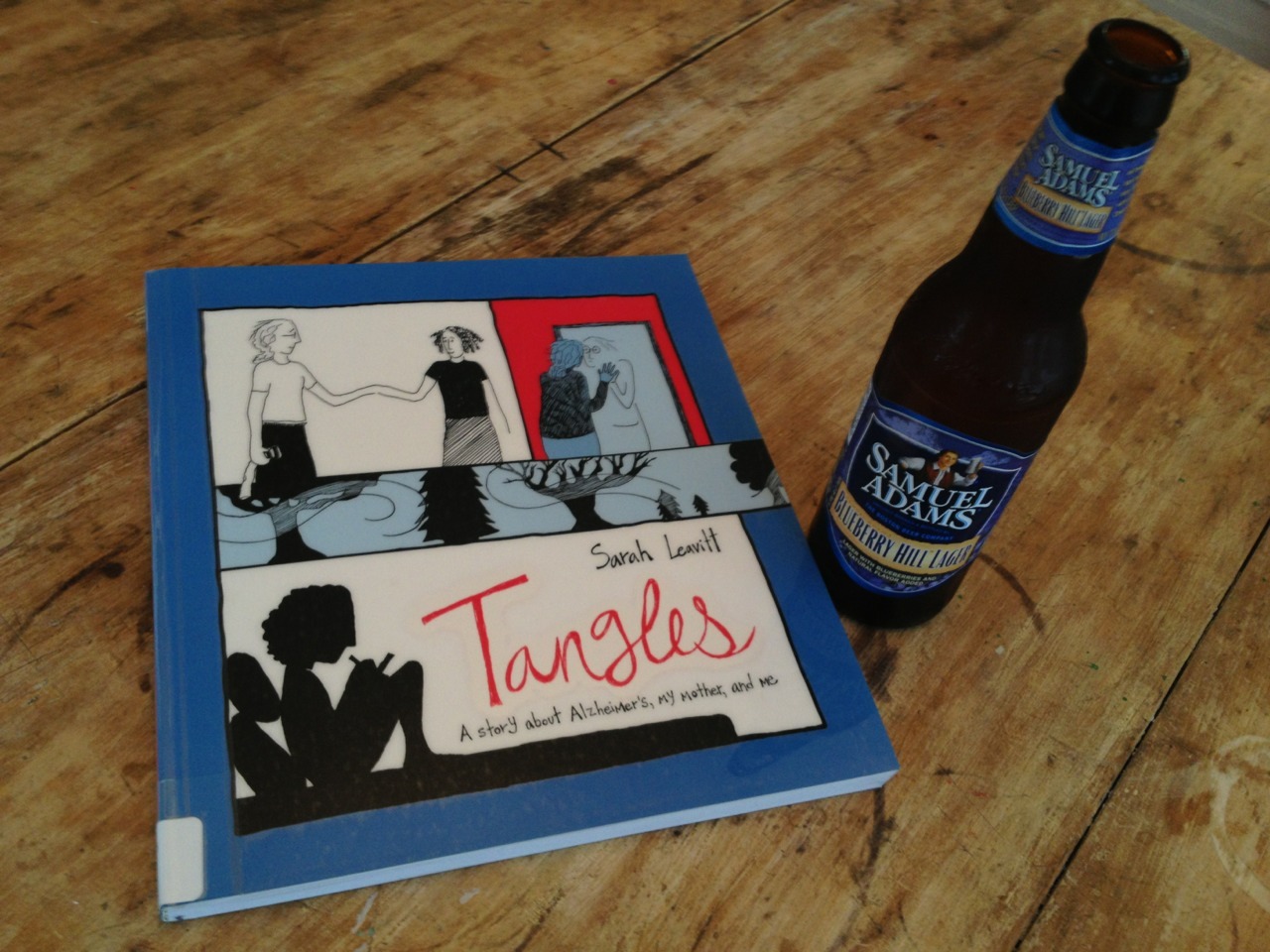
This is a very brave book. In Tangles, Sarah Leavitt recounts how her family lived with, dealt with, and was changed by her mother Midge's early-onset Alzheimer's (she began showing symptoms at only 52 years of age). We see an entire family coming to terms with this terrible illness, all in different ways, yet always out of love. It's not a guidebook for how to deal with Alzheimer's (how could it be?), but it is a record of what can be done, what might be done, and (only a couple of times) what perhaps shouldn't be done.

Tangles is simply awash in tiny details, thanks to Leavitt's coping mechanism of recording, in words and pictures, hundreds (thousands?) of observations of--and quotations from--her rapidly changing mother. The book's first-person narration of these tiny details seems to beg the question, Was this person who talked to broccoli still the mother who raised my sisters and I, the woman so engaged in education, the wife so loving and loved? The answer seems to be "Yes and no," of course. There's still a core of the Midge that we're introduced to in the book's preliminary, historical sections, but there's also a new person, one who sings to herself (no longer with her sisters) while being bathed or who writes ungrammatical notes to her daughter.

As a cartoonist, Leavitt draws in an unadorned, highly simple--even simplistic--style. I at first thought the style too simple but eventually recognized it as direct and honest. The book is a chronicle of Leavitt's feelings and impressions as much as it is a record of specific events, and I think a more highly rendered style would only serve to fetishize the events and overpower her impressions.

The book's large, square pages are generally constructed of five tiers of gutterless panels, leading to a dense reading experience; a lot happens on each page, and Sarah, our narrator, is often at a loss in trying to make sense of it all. How can you make sense of that which so often, by definition, is nonsensical? Such as the note from Midge to Leavitt's partner Donimo, which Leavitt reproduces, isolated in the corner of an otherwise blank page: "Love to Donimo / Hope you like Bmdows. / See you soon / family is / The whole / eags to see you / from Midge" (page 69).

The book is peppered with such large, nearly empty pages, falling in between some of the short, dense chapters. They often highlight quotations from Midge, or simple, striking moments: Actions divorced from time and context, much like Midge's perception of the world around her. Because it is so honest, Tangles is sometimes not an easy book to read. But it is a powerful one.


Tangles: A Story about Alzheimer's, My Mother, and Me
by Sarah Leavitt
Skyhorse Publishing, 2012
ISBN-10: 1616086394
ISBN-13: 978-1616086398
128 pages, $14.95


Thursday, June 6, 2013

Review: Moby Dick (Cozy Classics) by Jack & Holman Wang

Boardbook
Adaptation
Literature
Twelve:
     Words
     Photos
Art
Needle-Felt
Clever
Beautiful
Genius
(website)

Cozy Classics: Moby Dick
by Jack & Holman Wang
Simply Read Books, 2012
ISBN-10: 1927018110
ISBN-13: 978-1927018118
24 pages, $9.95

Monday, June 3, 2013

Review: Daredevil by Mark Waid vols 1 & 2, by Waid, Rivera, Martin, Rios, Kano, Pham et al.

I haven't read a new Daredevil comic book in many years, but I've heard enough about them to know that the character had been put through the wringer time and again, and that the title was known for being psychologically dark. Daredevil's secret identity as blind lawyer Matt Murdock had been made public (more than once?); he had become crime lord of New York (I think); he had been replaced by The Black Panther. In other words, typical high-impact superhero soap opera, though even grittier and more morally ambiguous than most.

But when Marvel Comics re-launched the title (yet again!) in 2011, it was announced that the character was headed in a new direction--or, should I say "old," for this new series, under writer Mark Waid, would be a return to the character's "lighthearted acrobat" roots, albeit one that would somehow not wipe away the character's more recent dark developments. Intrigued, I picked up the first two collected volumes from the library. What I found was a solid superhero comic, often visually innovative, which did indeed rekindle the sense of adventure and fun I recall from my own childhood reading of the character.

The gist of writer Waid's approach is that Murdock has survived being put through hell, and his coping mechanism is to treat life as a laugh (mostly--he is still a lawyer and crime-fighter, after all). While his secret identity was made public, the public's reaction to news is fickle, so while some people still believe that Murdock is Daredevil, others are unsure. Matt sometimes wears an "I'm Not Daredevil" shirt to deflect suspicion (though why that wouldn't just reconfirm said suspicion isn't exactly clear). His reputation makes it difficult for any clients he or his partner Foggy Nelson represent to get a fair trial, so he comes up with a new tactic: Their law firm will take on clients whom no one will represent and then coach them how to act as their own counsel, thereby allowing them to go to court without the distraction of all the "Daredevil" innuendos that follow Murdock wherever he goes. It's a narrative conceit that is as clever as it is utterly ridiculous; thankfully there's enough super-action that we don't see too, too many of these cases.

The artwork is in keeping with this lighter narrative approach. Particularly in the case of artist Paolo Rivera, we get characters composed of clean lines (if often a bit stiff in the staging) and innovative, almost bouncy page layouts. There are some new tricks to represent Daredevil's "radar sense" (often red contour lines over black backgrounds, as well as tiny inset panels which draw our attention to small details, highlighting Murdock's own heightened view of the world) as well. Even Rivera's cover to the first collection (which was also the cover to the first new issue) plays with how Daredevil exists in a world without vision: everything in the background environment is composed of words, representing how his brain "molds" objects out of sound. Examples: birds are built out of the words "flap flap flap," a water tower out of "glug gurgle drip drop," exhaust out of "hsssss." And Daredevil holds one of his billy clubs directly in front of his eyes, emphasizing for the reader the character's sightlessness.

The stories also work thematically with the character's attributes, pitting him against adversaries like Klaw (a being composed of solidified sound) and the nearly blind Mole Man--both, I think, for the first time. He also teams up with Spider-Man (a character with whom he has a long history) and hooks up with The Black Cat (a morally grey acrobat herself). And the macguffin of the OmegaDrive (a quantum hard drive containing information on several crime families and syndicates) ensures that Daredevil is never far from a tussle with any one of Marvel's many mafia surrogates.

All in all, these are solid, well-crafted superhero stories, light-hearted (usually) but not light-weight.

Daredevil by Mark Waid vol. 1
by Mark Waid, Paolo Rivera, Marcos Martin et al.
Marvel, 2012
ISBN-10: 0785152385
ISBN-13: 978-0785152385
152 pages, $15.99

Daredevil by Mark Waid vol. 2
by Mark Waid, Paolo Rivera, Emma Rios, Kano, Khoi Pham et al.
Marvel, 2012
ISBN-10: 0785152407
ISBN-13: 978-0785152408
136 pages, $15.99

Wednesday, May 29, 2013

Review: Springsteen on Springsteen: Interviews, Speeches, and Encounters, ed. Jeff Burger

I first saw Bruce Springsteen and the E Street Band perform in 1985 at Soldier Field in Chicago (I had won the tickets from a radio call-in contest), the second year (second year!) of the Born in the U.S.A. tour. The stage was in the football field's end zone, and in my memory, my friend from high school Jim and I were standing on about the 20-yard line at the stage-end of the field, although now I can't believe we actually managed to get anywhere near that close. Wherever we were standing (standing, for three-plus hours), I could see things pretty well, given my height and the presence of huge video screens. Even though by that point the band was playing ten of the new album's twelve songs, eschewing some older classics (where oh where was "Rosalita (Come Out Tonight)"?), it was still an amazing, life-enriching show for me, and for the probably 60,000 other people in attendance.

1985. 60,000 people.

Here's Springsteen in an unpublished interview from 1974, eleven years prior:
Usually we won't play anyplace over three thousand [people]--that's the highest we want to do. We don't want to get any bigger. And that's even too big....
P[aul] W[illiams]: But then there's The Who. They announce they're playing Madison Square Garden and it sells out in an hour. So I guess they'd have to book a week, a whole week.
BS: You gotta do that. And if you get that big, you gotta realize that some people who wanna see you ain't gonna see you. I'm not in that position and I don't know if I'll ever be in that position. All I know is those big coliseums ain't where it's supposed to be. There's always something else going on all over the room....
PW: I guess people go for the event.
BS: What happens is you go to those places and it turns into something else that it ain't. It becomes an event. It's hard to play. That's where everybody is playing, though, I don't know how they do it. I don't know what people expect you to do in a place like that. Especially our band--it would be impossible to reach out there the way we try to do. Forget it! (pages 34-35)
But Bruce and the band not only fairly soon managed "the impossible"; they became the undisputed, three-hour-plus masters of it, and have remained there for close to four decades.

In Springsteen on Springsteen, editor Jeff Burger allows us to see how Bruce was able to develop from a pretty inarticulate but hungry young artist into one of rock's elder statesmen and most eloquent spokespersons. Burger has gathered interviews, speeches, and more, ranging from a profile from 1973 to Springsteen's keynote address to the South by Southwest Music Festival in 2012. (The book is also peppered with "Bruce Bits," snippets of other interviews that touch on ideas not covered in the full-length pieces.) I've read several books about Springsteen in the past couple of years (most recently Bruce by Peter Ames Carlin), and each have their strengths, but this one does a wonderful job of demonstrating Springsteen's ever-evolving sense of himself as an artist.

His early interviews reveal an incredibly prodigious songwriter who was nevertheless very cautious--even guarded--when it came to how much of his music he presented his music to the public. Later in life, though, he began opening his vaults, beginning with the four-disc set Tracks (1998). There was evidence of this shift in perspective a few years before that, though, such as in this Guitar World interview with Neil Strauss in 1995:
Certainly, I go back and realize that there are many outtakes that should have been released at different times. I still wish I'd put more records out, and maybe I could have. But I made records very purposefully, with very specific ideas of them being about  and representing certain things. That probably caused me to be overly cautious about what I released and what I didn't. I certainly feel a lot more freedom now. (page 200)
It becomes clear when reading the earlier pieces that the feeling of freedom he felt in the 90s came for him only after consciously and meticulously shaping his early career along specific thematic lines.

And for a performer who's now known for his political activism, appearing on behalf of politicians like John Kerry and Barack Obama, he was for a long time reticent to espouse any overtly political rhetoric, although his populist sympathies generally weren't hard to spot in his lyrics. Even in the 1990s, an invitation from then-President Bill Clinton wasn't enough to tempt him, as David Corn inquired in a Mother Jones interview (1996):
DC: The White House wanted you to drop by today, but you chose not to.
BS: What ears this man has! [Laughs.] I don't know what to say. In my opinion, the artist has to keep his distance. (page 217)
Springsteen seems to have avoided many sorts of temptation. Unlike just about every other rock or pop musician you can think of, he never fell prey to the dangers of chemical addiction. Indeed, several early reviews make a point to mention his tea-totaling ways. By the 1990s, though, interviewers occasionally set the set the scene for their pieces with tales of Springsteen offering to share some beer or Jack Daniels, drinks which the performer then barely touches (if at all) for the duration of the interview. Gavin Martin, from the New Musical Express, brought up the subject of drugs in 1996, and Springsteen replied:
I've had a funny experience in that I didn't so any drugs; I've never done any drugs. It's not about having any moral point of view about drugs whatsoever--I know nothing about them.... I didn't trust myself into putting myself that far out of control. I had a fear of my own internal life....
 I was 'round very many people who did many drugs and I can't particularly say I liked any of them when they were stoned or high, for the most part. Either they were being a pain in the ass or incomprehensible. That's my experience--so it didn't interest me.
Also, at a very young age, I became very focused on music and experienced a certain sort of ecstasy, actually, through playing. It was just something I loved doing. (page 225)
One of the strengths of this book is that editor Burger didn't just collect old interviews; he also contacted the interviewers and asked for any background stories or years-later comments they might have. One good example is the introduction to Springsteen's Advocate interview with editor-in-chief Judy Weider (1996). In comments to Burger, Weider placed Bruce's rhetoric in a specific political and personal context:
"Probably the most significant contribution made by Bruce in the interview (aside from revealing his own struggle with how he'd really feel if one of his own children turned out to be gay) came when e discussed marriage for LGBTs. It is important to remember that this was 1996; I had the heads of our own gay organizations cautioning me not to push for marriage. 'Civil unions are enough for now. People are not ready.' It drove me nuts. But Bruce not only understood that was an equal-rights issue, he pushed for gays and lesbians not to settle for less in this interview. His clarity and passion gave me extra backbone for my own ongoing fight over the years: '[Marriage] makes you a part of the social fabric. You get your license; you do all of the rituals.... [It's] a part of your place in society and in some way part of society's acceptance of you.'
"No one has said it better in my view," Wieder concluded. "The world is catching up to Bruce even now." (pages 234-235)
Again, these later pieces demonstrate a sense eloquence that simply wasn't there in the early days. I recall reading a Rolling Stone interview back in 1984 or 1985 (not included in this book) and wondering more than once how someone who could write lyrics with such directness, power, and beauty could so often speak so hesitantly. How could the man whose poetry I admired be so, well, inarticulate so often? This was before I began doing some writing and public speaking myself, before I learned that my own best self came not through extemporaneous speech but through carefully considered and crafted prose. Revision is the key to good writing, and Springsteen has always been a notorious reviser of his lyrics.

As we see over the course of this collection, Springsteen took revision in all forms seriously, and eventually got to the place where he spoke to reporters not hesitantly but thoughtfully and reflectively, with all of the care and craft his lyrics exhibited. Nick Hornby introduced his Observer Music Monthly interview in 2005 in part by noting:
[Springsteen's] answers came in unbroken yet carefully considered streams. He is one of the few artists I've met who is able to talk cogently about what he does without sounding either arrogant or defensively self-deprecating. (page 313)
In an interview with the actor Ed Norton in 2010, Springsteen channels a filmmaker to give one of the best examples I've read of a description of an artist: "Martin Scorsese said the artist's job is you're trying to get the audience to care about your obsessions" (page 354). And later that year on Australian television with interviewer Ian "Molly" Meldrum, he positioned himself as a particular kind of artist: a storyteller.
If you look at the role of storytellers in communities going back to the beginning of time, they played a very functional role in assisting the community and making sense of experience, of the world around them, charting parts of their lives, getting through parts of their lives. I was interested in the eternal role of storyteller and songwriter and how I was gonna perform that function best. (page 369)
The Bruce Springsteen of 1974, at least the public speaker, never mentioned ideas like this. But did he think things like this? The Springsteen of 2010 says he did. Can we gainsay him that? For an artist whose first two albums especially delighted in the play and sound of words, his interviews--his honest, raw declarations "for the record"--took quite a long time to catch up and become lyrical in and of themselves. Perhaps he needed to hone not just his song-craft but his larger word-craft over time. The young Springsteen's speech strikes us as a bit crude and unfinished; the elder man speaks in sharp-edged, purely forged prose.

Springsteen on Springsteen not only traces the career of a songwriter; it chronicles the development of a thinker. As the imagery in his songs became more direct, more focused on the real world than on flights of verbal fancy and epics of escape, Springsteen's inner life blossomed to the point that his everyday speech could speak of hopes and dreams, of aspirations and heartache, with a beauty and a power and a poetry all its own.  In assembling these interviews spanning nearly four decades, Jeff Burger helps us to build a complex, evolving portrait of a performer, of a human being who grew into being the boss of his own mind.

Springsteen on Springsteen:
Interviews, Speeches, and Encounters
ed. Jeff Burger
Chicago Review Press, 2013
ISBN-10: 161374434X
ISBN-13: 978-1613744345
428 pages, $27.95


Monday, May 27, 2013

Review: Bluebird, by Bob Staake

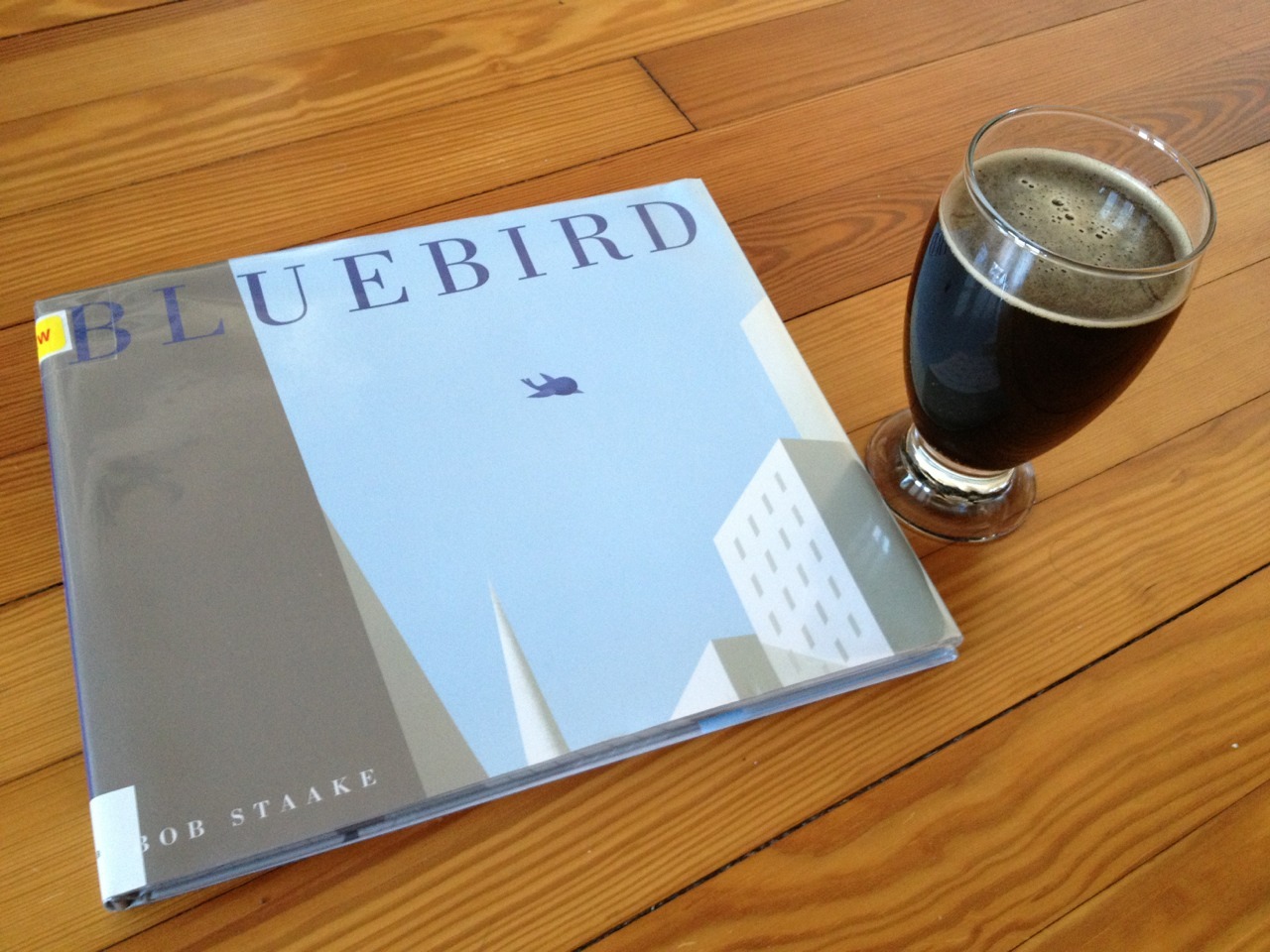
Bluebird, the new wordless picturebook by Bob Staake, is, quite simply, gorgeous. It tells the relatively simple story of a lonely New York City boy who meets and has his life changed by a bluebird. It's a tale of sadness, friendship, loss, and renewal, presented in comics-style, multi-panel pages colored primarily in blues, greys, and white.

Staake's geometric style ("rendered," as the indicia informs us, "in Adobe Photoshop") seems at first glance as if it might be cold; but, as anyone familiar with his other books or his illustration work for The New Yorker and elsewhere already knows, his spheres and boxes and cones are capable of conveying and creating deeply emotional scenes, from the little boy's downcast eyes and defeated posture in the book's beginning; to the wonder of the city's architecture, both grand and mundane; to the threatening moments in the woods of the park; to the freedom and exhilaration of the skies. Rarely have such simple shapes seemed so full of life.

Wordless (or "silent") books of course rarely have no words at all; while these pages don't offer narration or dialogue, we can still see words on signs or on classroom blackboards. And Staake's backgrounds are always worth exploring. Young eyes will have a lot to take in once they've devoured the main plot. I particularly liked the poster on the classroom wall which hearkens back to Staake's dedication in the front of the book.

The publication design here is elegant. Picturebooks often provide immersive book experiences like this for their young readers, and Bluebird is no different: The story actually begins on the front cover, where we meet the bluebird and then follow its flight across the city over the course of the front endpapers and then the indicia and title pages.

At turns melancholic and joyous, but always lyrical, Bob Staake's Bluebird belongs on the bookshelf of every child who's ever felt alone in or confused by the world around them--which is to say, of course, all children, current and former.

Bluebird
by Bob Staake
Schwartz & Wade, 2013
ISBN-10: 0375870377
ISBN-13: 978-0375870378
40 pages, $17.99

Saturday, May 18, 2013

Review: Hellraisers: The Life and Inebriated Times of Richard Burton, Richard Harris, Peter O'Toole, and Oliver Reed, by Robert Sellers

A complicated book about complicated people.

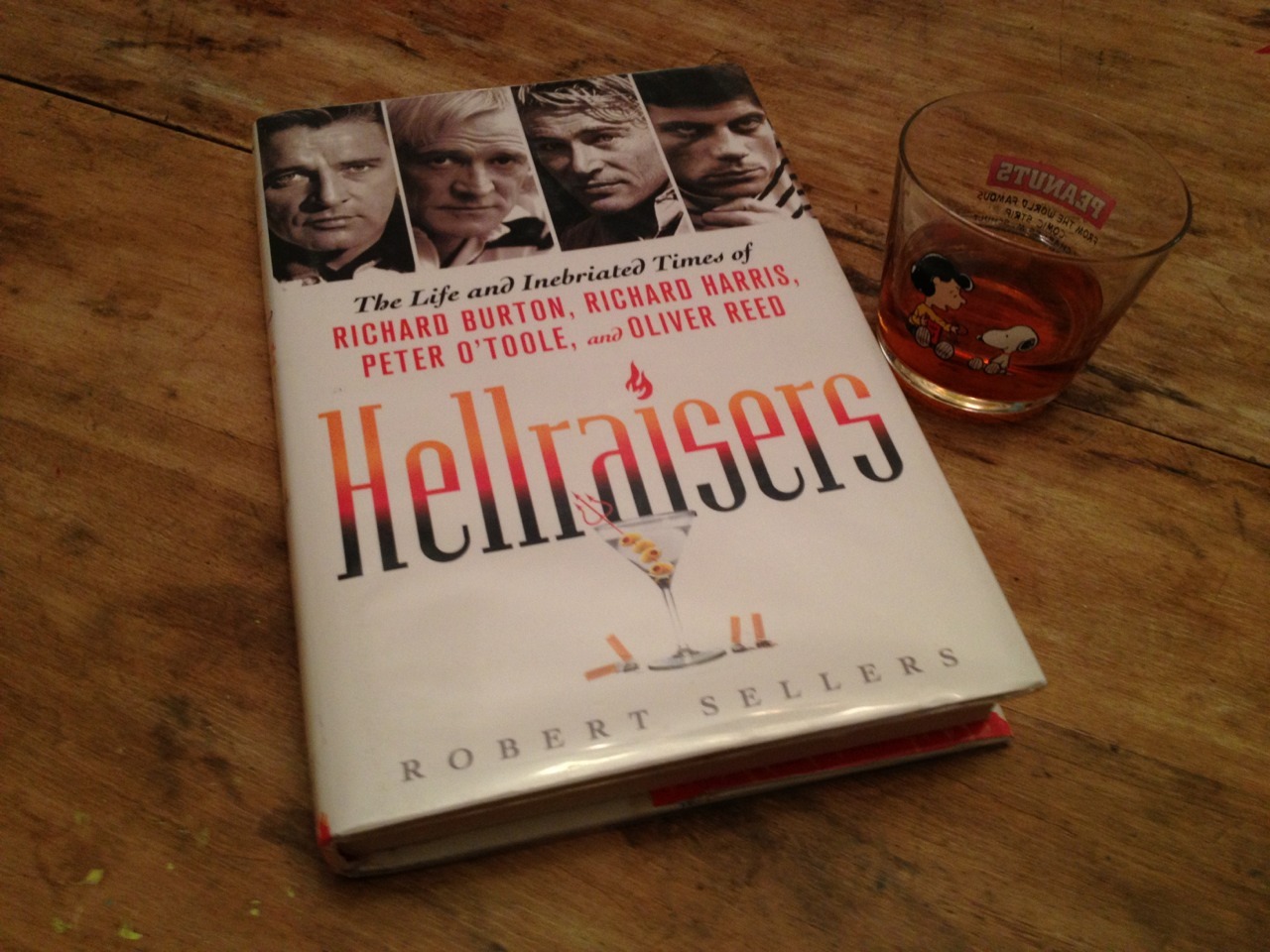
In Hellraisers: The Life and Inebriated Times of Richard Burton, Richard Harris, Peter O'Toole, and Oliver Reed, author Robert Sellers gives us the lives of four of the UK's greatest actors and wildest partiers of the twentieth century. Not their complete biographies, of course (the book is far too brief to encompass four lives completely). After brief childhood histories, Sellers dives into the meat of his book: Stories of drinking, carousing, and general craziness, fueled nearly entirely by alcohol (and occasionally controlled substances). The tales do cover each man's entire career, so we can say that you get at least their mini-biographies along the way, though seen through alcohol-tinted lenses.

The stories are by turns hilarious, outrageous, and, ultimately, more than a bit sad. One by one, the tales can incite peals of laughter or exclamations of "How could anyone possibly do that?" Stories of drinking binges that last not just for nights but for days; lives lived without keys, leading to being stopped by the police for breaking into one's own home through the window; interviews with journalists that are, in point-of-fact, imbibing contests. Just flipping through the photograph section leads to amazement:
[Richard] Burton was crippled by ill health later in life. In fact, during one operation surgeons were astonished to discover that Burton's entire spinal column was coated with crystallised alcohol.
[beneath a photo of Oliver Reed balancing horizontally on a bar, supported only by his hands] Reed celebrates knocking back 126 pints of beer in just 24 hours--about 12 minutes per pint.
[Richard] Harris often had no recollection of his hellraising. One morning, he was bemused to find stitches in his face, totally unaware that he'd wrecked a restaurant the night before.
In Paris shooting What's New Pussycat?, [Peter] O'Toole saw two policemen attacking a prostitute and later took revenge by duffing up a totally innocent gendarme.
However, after 280 pages of this behavior--actually, well before then--the novelty and shock value wear off, and one begins to weary of wasted potential. Undoubtedly, each actor gave some momentous, never-to-be-equaled performances on stage and screen; but just as often, if not moreso their performances were marred by impairments, sometimes disgracefully so. And pity the women who married them (except, perhaps, Elizabeth Taylor, who seems to have been at least Burton's equal in temperament and impairment, if not his better) and their children, who so often lived learning more about their fathers from the news than from their daily influence.

The book contains hundreds of tales of outrageous behavior, both public and private. I only thought to track down one of them: Peter O'Toole's infamous appearance on The Late Show with David Letterman, in which he comes on stage riding a camel. It's on Youtube for your viewing pleasure:


Sellers' version follows the same general shape of the actual event, but it also contains (as Huckleberry Finn would call them) some "stretchers," with certain elements elaborated on and others invented for more dramatic effect. I'm not sure if the changes are due to faulty memory on Sellers' part or a desire to make the event even more outrageous than it already was; but if this single fact-check can turn up errors, it leads me to wonder how much of the other material in the book has also been "enhanced." Don't get me wrong: Even if only 50% of the stories in the book happened as actually depicted, the book's title would be more than fully justified. It is just disappointing to realize that a "non-fiction" book exhibits a loose grasp of its own contents.

Ultimately, one takes away from Hellraisers a renewed appreciation for what these four actors managed to accomplish on and off the screen, as well as regret for what might also have been if only their behavior hadn't been quite so hellacious. Or did the greatness of their art necessarily depend on habitual insanity? And if so, was the chaos that behavior caused to their relationships worth it in order for the rest of us to experience their art? These questions, unfortunately, are not ones that Hellraisers is equipped to answer.

(PS: The author's prose suffers from perhaps the worst case of "British comma aversion" I have ever encountered. Note to authors and their editors: Commas are necessary for direct address and the appositive, but their misuse can lead to run-on sentences verging on parody.)


Hellraisers: The Life and Inebriated Times of
Richard Burton, Richard Harris, Peter O'Toole, and Oliver Reed
by Robert Sellers
Thomas Dunne Books / St. Martin's Press, 2009
ISBN: 9780312553999
286 pp, $25.99


Wednesday, May 8, 2013

Review: Henry & Glenn Forever, by Igloo Tornado

What is Henry & Glenn Forever? If, like me, you've been living under a rock since 2010, you might need an introduction. The one from the book itself ought to do:

Henry [Rollins] and Glenn [Danzig] are very good "friends."
They are also "room mates."
Daryl [Hall] and John [Oates] live next door.
They are satanists.

That's all you need to know.

Sounds like the set-up for an in-your-face, sure-to-offend exercise in excess, right? Well, think again, because the best adjective I can come up with for H+G=4EVA (apart from "hilarious") is "charming." In casting these hard rock/metal icons as gay lovers, the cartoonists of Igloo Tornado (a collective consisting of Tom Neely, Gin Stevens, Scot Nobles, and Levon Jihania) chose--wisely--to focus not on stereotypical "gay" tropes but, instead, to focus on the idea of "lovers." Thus, for example, we get several pages from Glenn's diary filled with his feelings of insecurity about his relationship with Henry:
i yelled at Henry the other day because he never does the dishes and i always end up being the one who cleans up after him. i wanna help him because he's so busy getting ready for his tour, but i'm so overwhelmed...
It's not all sadness and regret, however. The book is comprised of one-page comics and drawings, from diary entries and postcards, to single-panel gag cartoons, to repetitive headshots of the couple, with Henry saying something enigmatic and Glenn always--always--agreeing with him. My favorite comic, perhaps, consists of a conversation about painting the bathroom black: Glenn is brushing his teeth, and Henry's taking a bubble bath. Sheer domesticity. There are also running gags about Glenn's fixation with werewolves, and about the couple's missing dog that Seussian satanists Daryl & John may or may not know something about.

Silly, simple and a bit surreal, but never really exploitative, Henry & Glenn Forever nevertheless manages to convey more genuine emotion than many other "serious" graphic novels I've read. But it also includes a scene with all four main characters jamming to "Kiss On My List." Sublime, meet ridiculous.

Henry & Glenn Forever
by Igloo Tornado
Cantankerous Titles, 2010
ISBN-10: 1934620939
ISBN-13: 978-1934620939
64 pages, $6.00